Many entrepreneurs incorporate a company with high hopes, but sometimes due to market situations, funding problems, restructuring of businesses, or even personal reasons, the business comes to a halt either temporarily or permanently. After a company stops functioning, it raises many questions among promoters like:
The use of an incorrect method may cause unnecessary costs of compliance, sanctions, or problems in the resurrection of the company later on.
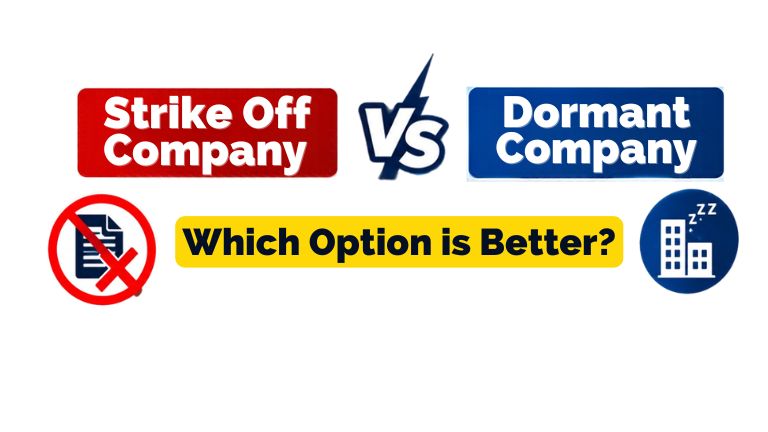
In this article, we will discuss Strike off versus Dormant Company under the Companies Act 2013, their benefits and drawbacks, and how to choose between the two for your business.
What is Strike Off?
The Strike Off procedure is one whereby the name of the company is stricken off the Register of Companies.
When the registrar of companies gives the approval, the company ceases to exist legally.
Such method is preferred in the following cases:
- The company has never commenced business.
- Business has permanently stopped.
- Promoters have no intention of restarting operations.
The application is generally made through Form STK-2, subject to the prescribed conditions.
What is a Dormant Company?
A Dormant Company is a company that is duly incorporated into law but does not indulge in any substantial business transactions.
Rather than shutting down the firm, the promoters preserve its legal entity, along with low compliance burden.
Dormant status is helpful when:
- Business is temporarily paused.
- Future projects are planned.
- Intellectual property or assets need protection.
- The company is held to have investment potential in the future.
Difference Between Strike Off and Dormant Company
| Particular | Strike Off | Dormant Company |
| Legal Status | Company ceases to exist | Company continues to exist |
| Business Operations | Permanently closed | Temporarily inactive |
| Compliance | Ends after closure | Minimal annual compliance |
| ROC Filing | STK-2 | MSC-1 (for obtaining dormant status) |
| Future Business | New incorporation required | Can reactivate anytime |
| Assets | Must generally be disposed of before strike off | Can continue holding certain assets |
| Bank Account | Closed | Can be maintained as permitted |
| Government Fees | One-time closure cost | Annual compliance cost |
| Suitable For | Permanent closure | Temporary inactivity |
Eligibility for Strike Off
A company may generally apply for strike off if:
- It has no business operations.
- It has no outstanding liabilities.
- Necessary statutory filings are completed.
- Shareholders approve the proposal.
- Pending litigations, if any, are appropriately disclosed.
- It satisfies the conditions prescribed under the Companies Act, 2013.
Eligibility for Dormant Company Status
A company may seek dormant status if:
- It is formed for a future project.
- It has no significant accounting transactions.
- It intends to preserve assets or intellectual property.
- It complies with the prescribed legal requirements.
- Annual dormant compliances can be maintained.
Advantages of Strike Off
1. No Future Compliance Burden
Once dissolved, annual ROC compliances are no longer required.
2. Cost Savings
No recurring audit, filing, or secretarial compliance expenses.
3. Avoid Future Penalties
Inactive companies often attract penalties for non-compliance. Strike off eliminates this risk after lawful closure.
4. Clean Exit
Provides a formal and legally recognized closure of business.
Advantages of a Dormant Company
1. Retains Corporate Identity
The company continues to exist legally.
2. Easy Business Revival
Business operations can be resumed by applying for active status.
3. Lower Compliance
Dormant companies have significantly fewer compliance obligations than active companies.
4. Preserves Brand Name
No other entity can use the company’s registered name while it remains in existence.
5. Suitable for Future Investments
Useful for startups planning to raise funding later.
Disadvantages of Strike Off
- Company cannot continue operations.
- Revival may require legal proceedings in certain cases.
- Existing contracts come to an end.
- A fresh incorporation may be necessary for future business.
Disadvantages of Dormant Company
- Annual compliance still continues.
- Certain statutory filings remain mandatory.
- Government fees continue.
- Non-compliance could lead to losing dormancy status and fines..
Which Option is Better?
The answer depends on your future business plans.
Choose Strike Off if:
- Business has permanently closed.
- No future operations are planned.
- There are no assets to preserve.
- You want to eliminate compliance costs completely.
Choose Dormant Status if:
- Business may restart later.
- You want to retain the company name.
- You own intellectual property.
- Future investments are expected.
- Business is temporarily suspended.
When is Strike Off a Better Alternative?
Strike Off is ideal when:
- Startup failed.
- Family business discontinued.
- No assets remain.
- No employees remain.
- No future business plans exist.
When is Dormant Status a Better Alternative?
Dormant status works well when:
- Waiting for regulatory approvals.
- Business expansion is postponed.
- Holding intellectual property.
- Preserving land or investments.
- Future fundraising is planned.
Compliance Requirements
Strike Off
Before applying:
- File pending annual returns (where applicable).
- Clear outstanding liabilities.
- Obtain shareholder approval.
- Close unnecessary accounts and complete required formalities.
- Submit Form STK-2 with the prescribed documents.
Dormant Company
Annual requirements generally include:
- Filing prescribed annual documents.
- Maintaining the minimum number of directors.
- Paying annual fees.
- Complying with applicable provisions for dormant companies.
Mistakes to Avoid
- Applying for strike off while liabilities remain unpaid.
- Ignoring pending ROC filings.
- Assuming dormant companies have no compliance obligations.
- Failing to obtain shareholder approval.
- Choosing strike off despite future expansion plans.
- Not seeking professional advice before making the decision.
Why to choose My Legal Business LLP?
Selecting the right option between Strike Off and Dormant Status requires careful legal analysis. At My Legal Business LLP, we help businesses choose the most suitable path based on their commercial objectives and compliance status.
Our Services Include:
- Expert advice on Strike Off and Dormant Company eligibility.
- Preparation and filing of STK-2 and MSC forms.
- Drafting Board Resolutions and Special Resolutions.
- Compliance review before filing.
- ROC documentation and end-to-end filing support.
- Assistance in converting dormant companies back to active status.
- Professional guidance to avoid penalties and legal complications.
No matter whether you decide to wind up your company or maintain it for the future use, our specialists make sure that everything goes smoothly.
Conclusion
The difference between Strike Off and Dormant Company lies in the fact that both are used by firms for various reasons. The former is used by those firms that wish to terminate their activities permanently and want to wind up themselves, whereas Dormant Company suits those firms that want to retain their corporate identity and do not wish to be involved in much compliance.
To make a decision, consider your goals and financial position, and seek professional advice to make sure that whatever you choose suits you and meets the requirements of the Companies Act, 2013.
To decide which one suits your firm, My Legal Business LLP provides comprehensive solutions regarding the assessment of your case and filing all the necessary papers.
Frequently Asked Questions (FAQs)
1. What is the distinction between Strike Off and Dormant Company?
In strike off, the firm is permanently deleted from ROC register while in dormant company, firm is inactive but still legally registered.
2.Can the business of a struck-off company be resumed?
Generally, a struck-off company cannot continue business unless it is restored through the legal process, where applicable. Otherwise, a new company must be incorporated.
3.Is there any way to get back into business as a dormant company?
Yes, A dormant company may request to go back into operation provided it meets the necessary legal formalities
4. Which choice is cheaper?
In Strike Off, the company will have only one expense of closing down the business, but Dormant Companies have annual expenses.
5. Does a dormant company file its annual returns?
Dormant companies have reduced compliance obligations but are still required to meet certain annual filing requirements prescribed by law.
6. Can a company with liabilities apply for Strike Off?
Generally, a company should settle its liabilities before applying for voluntary strike off, subject to applicable legal requirements.
7. Is shareholder approval required for Strike Off?
Yes. Approval of shareholders is generally required before making a voluntary strike-off application.
8. Can a dormant company own property?
Yes. A dormant company may continue to hold assets, subject to compliance with applicable laws.
9. Is audit mandatory for a dormant company?
The compliance framework for dormant companies differs from active companies. Advice from experts needs to be sought according to the particular situation and relevant laws in place.
10. What is best for start-ups?
If founders plan to restart the business in the future, dormant status is usually the better option. If there is no intention to continue, strike off is generally more suitable.
ALSO READ
Closure of Private Limited Company via Strike Off
What is the Difference Between Winding Up and Strike Off
Can a Section 8 Company Be Struck Off
Revival of Struck off Company under the Companies Act, 2013
How to Check Company Name Availability on MCA Portal
Public Limited Company Compliance Calendar – Important ROC Filings