Running a Public Limited Company in India comes with significant responsibilities under the Companies Act, 2013. Unlike a private company, a public company generally has a wider shareholder base and may be subject to additional governance and disclosure requirements.
Keeping track of ROC filings, AGM-related compliances, director compliances, auditor filings and event-based forms is therefore essential. Missing a statutory deadline can result in additional fees, penalties and other compliance consequences.
This guide provides a Public Limited Company Compliance Calendar for companies following a financial year from 1 April to 31 March.
What Is ROC Compliance?
ROC compliance refers to the statutory filings, disclosures, returns and other requirements that a company must complete with the Registrar of Companies (ROC) through the MCA portal.
These compliances arise under the Companies Act, 2013 and the rules made under it.
For a public company, common ROC compliances include:
- Annual return filing
- Financial statement filing
- Auditor-related filings
- Director-related filings
- Disclosure of deposits and outstanding amounts
- Filing of resolutions
- Registration and modification of charges
- Changes in directors and Key Managerial Personnel (KMP)
- Other event-based filings
The exact forms applicable depend on the company’s size, listing status, business activities and specific transactions.
Why Is ROC Compliance Important for Public Companies?
ROC compliance is not merely a formality. The information filed with the MCA forms part of the company’s statutory records and provides transparency regarding its financial position, ownership, management and corporate activities.
Section 92 requires companies to prepare an annual return containing information such as registered office, shareholding, members, directors, KMP and meetings. The annual return is generally required to be filed within 60 days of the AGM.
Similarly, under Section 137, financial statements adopted at the AGM are generally required to be filed with the ROC within 30 days of the AGM.
Therefore, maintaining a compliance calendar helps the company avoid missed deadlines and unnecessary additional fees.
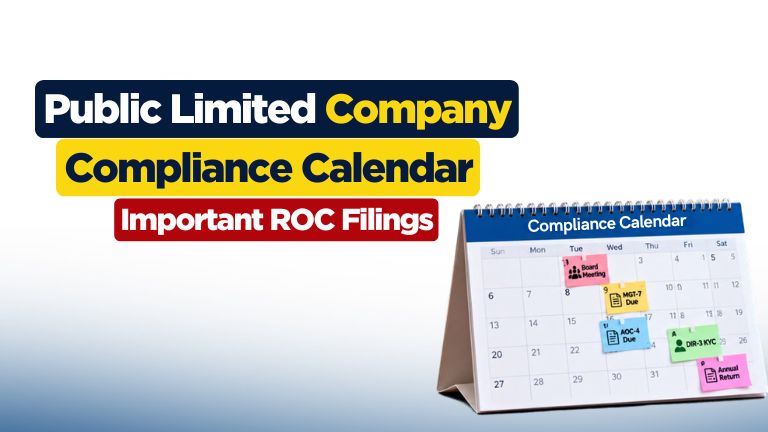
Public Limited Company Compliance Calendar
For a company having a financial year ending on 31 March, the following is a useful annual compliance framework:
| Compliance | Form | Usual Due Date |
| DPT-3 | DPT-3 | 30 June |
| AGM | – | Generally by 30 September |
| DIR-3 KYC | DIR-3 KYC / applicable KYC filing | As prescribed for the relevant year |
| Auditor appointment/re-appointment | ADT-1 | Within 15 days of AGM |
| Financial Statements | AOC-4 / applicable form | Within 30 days of AGM |
| Annual Return | MGT-7 | Within 60 days of AGM |
| AGM Report, where applicable | MGT-15 | Within 30 days of AGM for applicable listed companies |
| Director/KMP changes | DIR-12 | Within prescribed period from the event |
| Charges | CHG-1/CHG-4/other applicable forms | Within prescribed statutory period |
| Resolutions | MGT-14 | Within prescribed period, wherever applicable |
The exact due date should always be checked against the actual AGM date, company’s status and applicable MCA rules/circulars.
Important Annual ROC Filings
A. DPT-3 – Return of Deposits
DPT-3 is generally filed annually by companies to provide information regarding deposits and/or specified outstanding receipts covered by the applicable rules.
The usual statutory due date is 30 June for information as prescribed under the applicable rules.
Companies should reconcile their books and identify outstanding loans, deposits and other relevant amounts well before the filing deadline.
B. DIR-3 KYC – Director KYC
Directors holding a DIN are required to comply with the applicable annual KYC requirements.
The company should ensure that all its directors have completed their required KYC within the applicable deadline.
Failure to complete the required KYC can result in the DIN being marked as non-compliant/deactivated until the required filing or process is completed.
C. ADT-1 – Auditor Appointment
Where applicable, the company is required to intimate the ROC regarding the appointment or re-appointment of its statutory auditor through Form ADT-1.
The general filing period is 15 days from the date of the meeting at which the auditor is appointed or re-appointed.
The company should verify the auditor’s consent, eligibility and other required documents before completing the filing.
D. AOC-4 – Filing of Financial Statements
AOC-4 is used for filing the company’s financial statements and applicable documents with the ROC.
Under Section 137, financial statements are generally required to be filed within 30 days from the date of the AGM.
Depending on the company and its financial reporting requirements, an applicable version such as AOC-4 XBRL or other prescribed forms may be required.
The filing may include documents such as:
- Balance Sheet
- Statement of Profit and Loss
- Cash Flow Statement, where applicable
- Notes to accounts
- Board’s Report
- Auditor’s Report
- Other applicable attachments
E. MGT-7 – Annual Return
Public companies generally file their annual return in Form MGT-7.
The annual return provides information relating to the company’s:
- Share capital
- Shareholders
- Directors and KMP
- Registered office
- Meetings
- Indebtedness
- Shareholding pattern
- Other prescribed corporate information
Section 92 generally requires filing of the annual return within 60 days from the date of the AGM.
For eligible companies, the annual return may also require certification by a Practising Company Secretary, depending on the applicable statutory thresholds and provisions.
Event-Based ROC Filings
Apart from annual filings, public companies may have several event-based compliances.
For example:
Change in Directors or KMP – DIR-12
If a director or applicable KMP is appointed, resigned or otherwise undergoes a change requiring filing, DIR-12 may be required within the prescribed period.
Creation or Modification of Charge – CHG-1
When a company creates or modifies a charge on its assets, the applicable charge form, such as CHG-1, may need to be filed with the ROC.
Satisfaction of Charge – CHG-4
Once a registered charge is satisfied, the company generally needs to file the prescribed satisfaction form with the ROC.
Filing of Resolutions – MGT-14
Certain resolutions and agreements are required to be filed with the ROC in MGT-14 within the prescribed timeline.
Allotment of Shares – PAS-3
Where shares or other securities are allotted, PAS-3 may be required within the applicable statutory period.
These forms are event-based, so they cannot be treated as fixed annual filings.
AGM-Related Compliance
The AGM is one of the most important events in the annual compliance cycle.
For most companies with a 31 March year-end, the AGM is generally required to be held within six months from the end of the financial year, subject to the provisions of the Companies Act.
The AGM generally deals with matters such as:
- Adoption of financial statements
- Consideration of Board’s Report and Auditor’s Report
- Declaration of dividend, where applicable
- Appointment/re-appointment of directors, where applicable
- Appointment/re-appointment of auditors
- Other ordinary or special business
Once the AGM is completed, important ROC filing timelines begin to run, particularly for ADT-1, AOC-4 and MGT-7.
Consequences of Missing ROC Filings
Failure to comply with ROC filing requirements can result in:
- Additional government fees
- Statutory penalties
- Penalties on officers in default
- Difficulty in completing subsequent filings
- Compliance issues during due diligence
- Problems during fundraising or corporate transactions
- Potential regulatory action in serious cases
For example, Section 92 provides statutory consequences for failure to file the annual return within the prescribed period.
The financial impact of delayed filing can increase significantly when a form remains pending for a long period.
Compliance Tips for Public Limited Companies
A public company should maintain a year-round compliance system rather than preparing filings only when the deadline is approaching.
Maintain a Compliance Calendar
Record every statutory due date and assign responsibility to a specific person.
Start Preparing Before the AGM
Financial statements, Board’s Report, notices, registers and other documents should be prepared well in advance.
Reconcile Corporate Records
Before annual filings, verify:
- Share capital
- Shareholders
- Directors
- KMP
- Registered office
- Charges
- Loans and deposits
- Board and general meetings
Track Event-Based Compliances
Do not wait for the annual filing season. Any appointment, resignation, allotment, charge or other reportable event should be reviewed immediately.
Keep MCA Master Data Updated
The company’s MCA master data should be periodically checked to identify discrepancies in directors, registered office, capital and other information.
Conclusion
A Public Limited Company Compliance Calendar helps the company stay organised and avoid unnecessary penalties. While annual filings such as DPT-3, AOC-4, MGT-7 and applicable director KYC filings form an important part of the compliance cycle, companies must also monitor event-based filings such as DIR-12, PAS-3, CHG forms and MGT-14.
The most important point is that ROC compliance is a continuous process. Companies should maintain proper statutory records, monitor deadlines and review every corporate action for its applicable filing requirements.
For a public company, timely compliance not only helps avoid penalties but also supports good corporate governance, transparency and smoother future transactions.
Frequently Asked Questions (FAQs)
1. What are the main ROC filings for a Public Limited Company?
The common filings include AOC-4, MGT-7, ADT-1, DPT-3 and applicable DIR-3 KYC filings, along with various event-based forms.
2. When is AOC-4 due for a Public Limited Company?
AOC-4 is generally required to be filed within 30 days from the date of the AGM, subject to the applicable provisions and form requirements.
3. When is MGT-7 due?
MGT-7 is generally required to be filed within 60 days from the date of the AGM.
4. Is DPT-3 mandatory for every Public Limited Company?
The requirement depends on the company’s deposits, loans, outstanding receipts and other amounts covered by the applicable provisions. Companies should examine their financial records and the applicable rules before concluding whether DPT-3 is required.
5. Is ADT-1 required every year?
ADT-1 is not simply a routine annual filing in every case. It is generally filed when there is an appointment or re-appointment of the statutory auditor requiring such intimation.
6. Does a Public Limited Company need to file MGT-7?
Yes. Public companies generally file their annual return in MGT-7, subject to the applicable provisions.
7. What happens if ROC filing is delayed?
Delayed filings can attract additional fees and statutory penalties. The consequences depend on the particular form and applicable provision.
8. Are ROC filings required even if the company has no business activity?
A company’s compliance obligations do not automatically disappear merely because there is little or no business activity. The company should examine the applicable statutory requirements for each financial year.
9. Is AGM mandatory for a Public Limited Company?
Yes, subject to the specific provisions and exceptions under the Companies Act, a public company is required to comply with the applicable AGM requirements.
10. Why should a Public Limited Company maintain a compliance calendar?
A compliance calendar helps track annual filings, AGM deadlines and event-based compliances, reducing the risk of missed deadlines, additional fees and regulatory issues.
ALSO READ
Public Company Registration in India
Mandatory Generation of UDIN by PCS for e-Form MGT-7 Certification for ROC Filing
Procedure for Admission of Partner in LLP
Step-By-Step Process of Resignation of Director
Step-By- Step Process of Appointment of Managing Director Under Companies Act 2013