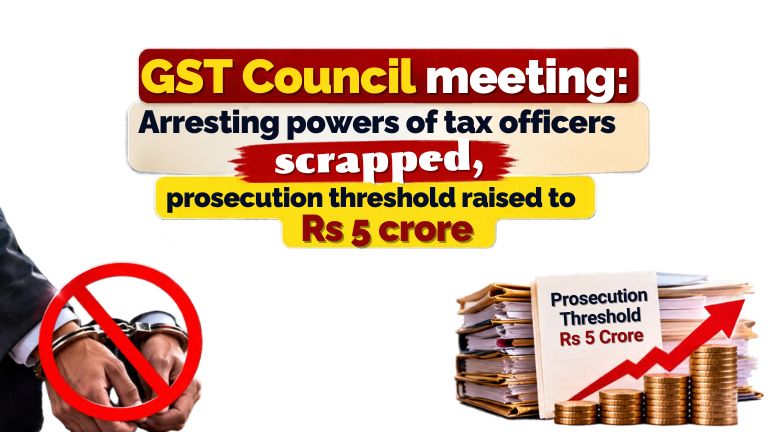
The GST Council has proposed significant changes to the country’s GST enforcement rules. In its 57th meeting on 8 October 2026, the Council recommended removal of the arrest provision under GST and raising the threshold for prosecution from Rs 1 crore to Rs 5 crore.
For business owners, these changes could reduce the risk of criminal prosecution in some tax matters. But that does not relieve you of the obligation to pay GST or follow tax rules. When a taxpayer breaks the law, interest, tax recovery and penalties may be applied.
The changes also give courts more leeway to decide on punishment in cases that result in conviction. GST Council arrest powers decision: What it means for companies, taxpayers and professionals
What’s the latest on GST council arrest powers?
The GST Council has proposed changes to the arrest and prosecution provisions under the Central Goods and Services Tax (CGST) Act, 2017. The goal is to limit the use of criminal penalties for tax offences, but not to prevent action against serious fraud and evasion.
The major changes are:
- Removal of arrest provisions under GST.
- Increasing the prosecution threshold limit from ₹1 crore to ₹5 crore.
- Amendments to certain offences under Section 132 of CGST Act.
- Abolition of the mandatory minimum six month term of imprisonment.
- Courts to have more discretion to decide whether to impose a fine, prison term or both.
These are the Council’s proposed changes to the law. “Businesses should check the relevant notifications and commencement dates before relying on them in a tax dispute.
Why has the GST Council removed arrest powers?
GST officers have the power to arrest people in certain situations where there are serious offences committed under GST law. ‘Businesses have expressed concerns over the use of these powers in tax investigations and disputes.
The decision of the GST Council seeks to delink tax recovery with criminal prosecution. A failure to pay tax or a tax dispute should not be treated as a criminal offence.
However, the lack of arrest powers does not mean that tax authorities have no power to investigate suspected fraud, determine tax liabilities or collect outstanding dues. Enforcement may be taken by the authorities under applicable law.
The change is designed to give businesses greater confidence, while not ruling out legal action in serious cases.
GST prosecution threshold increased from ₹1 crore to ₹5 crore
One of the main changes concerns the amount of tax evasion that can lead to prosecution.
Under the existing framework, the prosecution threshold for relevant offences was ₹1 crore. The Council has recommended raising it to ₹5 crore.
| Particulars | Earlier position | Recommended change |
| Prosecution threshold | ₹1 crore | ₹5 crore |
| Arrest provisions | Available under specified conditions | Removal recommended |
| Minimum imprisonment | Six months in specified cases | Mandatory minimum to be removed |
| Court’s choice of punishment | Subject to existing statutory rules | Fine, imprisonment or both |
What does the ₹5 crore limit mean?
A higher threshold level indicates that any amount above ₹5 crore in respect of an offense can be prosecuted as per the provisions of recommendation.
For example, a case involving the allegation of tax evasion of ₹3 crore would be below the threshold. But this does not imply that the person making the tax payment has got away with any consequences. There would be tax recovery, interest and even penalties applicable.
Should the amount cross ₹5 crore, then there may be a possibility of prosecution depending upon the offense and the law.
The threshold level does not make every tax issue a criminal matter.
How will the GST Council arrest powers decision affect businesses?
The changes could be a relief for businesses under GST investigation, particularly where a dispute is over the quantum of tax involved or classification of an offence.
1. Reduced risk of GST arrest
The proposed removal of arrest provisions would prevent GST officers from using arrest as an enforcement tool under the GST law. This may ease fears of arrest during investigations.
2. Higher threshold for criminal prosecution
The increase in the threshold to ₹5 crore may reduce the number of cases attracting provisions for prosecution. Businesses must still pay the tax that is due and respond to notices.
3. More discretion in punishment.
The Council has suggested that the mandatory minimum six-month jail term should be abolished. The courts would have more discretion to impose a fine, imprisonment or both depending on the law and facts of each case.
4. You still need to comply with taxes
Businesses will still need to file their GST returns, report transactions correctly and keep invoices and accounts. A lesser risk of criminal prosecution does not protect a business from demands for tax or penalties.
Does the new GST rule mean taxpayers cannot face prosecution?
No. The raising of the threshold for prosecution is a separate change from the removal of arrest provisions.
The Council has recommended to do away with the arrest provisions under GST. However, subject to the requirements of the law, where the amount involved is more than ₹5 crore, prosecution may be initiated before a competent court for relevant offences.
For instance, a company under investigation for serious tax evasion charges of more than ₹5 crore could still be prosecuted. The law would have to be met and the court would have to make a determination.”
The change should not be an excuse for business to avoid tax or to file false returns.
What other GST changes were announced?
In the 57th GST Council meeting, other compliance measures were also discussed.
- Lower general penalty: It was suggested to lower the maximum general penalty from ₹25,000 to ₹10,000.
- Faster refunds: The Council recommended system-based processing to enable faster GST refunds to eligible claimants.
- Small e-commerce sellers: The Council approved simplified registration norms for small sellers using e-commerce platforms.
- No change in GST rates: The meeting did not alter the existing GST rate structure.
These changes relate to different aspects of GST administration. Each measure should be looked at individually, as conditions and implementation dates may differ.
What should businesses do after the GST Council decision?
Companies need to ensure that their records for GST are updated and their obligations fulfilled.
Here are some tips:
- Go through the outstanding notices issued for GST and determine the tax period and matter at hand.
- Have your invoices, returns, payments, and input tax credit claims at hand.
- Act according to the notice within the deadline mentioned.
- Look for official notifications for the time when the recommendation will come into force.
- Consult a competent tax advisor in case of any inquiry or prosecution.
Just because the council has recommended changes in the law regarding arrest and prosecution, you cannot simply ignore the notice.
Conclusion
GST Council decision on arrest powers: Recommends abolishing arrest powers under GST, raising prosecution threshold from ₹1 crore to ₹5 crore. It would also provide judges with more flexibility in sentencing.
These changes may reduce the risk of criminal prosecution in some cases but tax recovery, interest and applicable penalties may be applied. Businesses should continue to comply with GST regulations and determine the legal position before acting on the recommendations.
MY LEGAL BUSINESS LLP offers professional assistance for GST compliance, business documentation or tax notices.
FAQS
1. Has the GST Council taken away the arrest powers of tax officers?
GST council suggests doing away with arrest provisions under GST. The change will come into force in accordance with the relevant amendments and their commencement dates.
2. What is the new limit of prosecution in GST?
GST Council recommends raising threshold for prosecution from Rs 1 crore to Rs 5 crore for relevant offences If the value exceeds ₹5 crore and the legal requirements are met, prosecution is still possible.
3. Can GST officers issue notices after the change?
Yes. The proposed removal of arrest provisions does not bar tax authorities from investigating the cases, issuing lawful notices and recovering the unpaid GST. Taxpayers must still respond to notices within the time prescribed.
4. Will businesses still be liable to pay GST penalties?
Yes. The proposed changes do not remove all GST liabilities and penalties. Even if the businesses do not comply with the GST rules, they will have to pay the outstanding tax, interest and applicable penalties.
5. Did there any change in GST rates after last Council meeting?
The 57th meeting of the GST Council on 8 October 2026 maintained the status unchanged on the rate structure as per the meeting summary used for this article.
ALSO READ
Top 10 Common Mistakes Businesses Make During GST Filing
Step-by-step Process of GST Registration