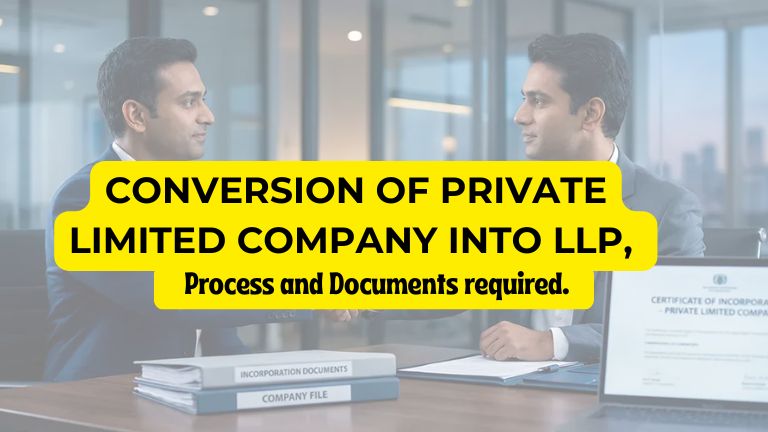
Private Limited Company is a business organization which is most popular in India. However, with a change in growth or operational strategy, promoters of many companies opt for conversion of the company into a Limited Liability Partnership (LLP) for reasons of reduced compliance burden and administrative overhead.
An LLP is a form of business organisation that offers the benefit of limited liability of a company along with the flexibility of organisation and management of a partnership firm. Most startups, consultants, and small businesses prefer the LLP structure as it has less compliance and is more cost-effective than a private limited company.
The LLP conversion for an existing company is based on the MoA and AoA of the Company which shall be applicable mutatis mutandis with respect to the LLP agreement. Provisions of the Act, the procedure for conversion of a Company into LLP is notified by the Ministry of Corporate Affairs, on fulfillment of specified conditions and making prescribed filings.
This guide covers the eligibility requirements, procedure, documents, advantages, and FAQs for converting a Private Limited Company into LLP in India in an easy way.
What is the Conversion of Private Limited Company into LLP
The Process of Conversion involves transforming the form of an existing Private Company into LLP without impacting the day-to-day business activities.
Once the conversion is approved:
- The company automatically converts into LLP
- All assets, liabilities, rights and obligations transfer to the LLP
- The company is dissolved and removed from the ROC register.
- Business continues in the name of the LLP
Why Businesses Convert Company into LLP
Many businesses prefer LLP over company due to the following reasons:
1. Less Compliance Burden
Companies are required to file several annual returns and maintain strict compliance. LLPs have simpler compliance requirements.
2. Lower Cost of Maintenance
Annual compliance cost of LLP is significantly lower than a private limited company.
3. Flexible Management Structure
In LLP, partners can manage operations directly through an LLP Agreement.
4. No Dividend Distribution Restrictions
Partners can withdraw profits without complex dividend procedures.
5. Suitable for Professional Firms
The LLP structure is commonly preferred by consultants, legal firms, CAs firms and service providers.
Eligibility Conditions for Conversion into LLP
The company shall meet the following requirements before making the application for conversion:
- All shareholders must become partners of the LLP.
- The company should not have any security interest on its assets.
- The company must have filed all ROC returns and compliances.
- Consent of all shareholders is required.
- Minimum two designated partners must be available in LLP.
- The company must not be involved in any pending regulatory restrictions.
In case of non-compliances with these terms, application may be rejected by MCA.
Step-by-Step Procedure for Conversion
Step 1: Get a Digital Signature Certificate (DSC)
All the designated partners are required to get a Digital Signature Certificate (DSC) in order to file online at the MCA portal.
Step 2: Apply for Name Reservation
The proposed LLP name must be reserved using RUN-LLP form on the MCA portal.
The name should comply with the naming rules under the LLP Act.
Step 3: File Incorporation Form (FiLLiP) and linked Form 18
The FiLLiP form is filed to incorporate the LLP and provide details of partners, registered office, and capital contribution.
Form 18 is specifically used for conversion of a private limited company into LLP and it is linked form to Fillip.
This form includes:
- Company details
- Shareholder information
- Statement of assets and liabilities
Step 4: Issue of Certificate of Registration
After verification, MCA issues a Certificate of Incorporation of LLP confirming the conversion.
Step 5: File LLP Agreement
The LLP Agreement must be filed in Form 3 within 30 days from date of receiving conversion certificate of incorporation.
The agreement defines:
- Profit sharing ratio
- Partner duties and rights
- Management structure
6. Documents Required for Conversion
The following documents are required for conversion:
- List of shareholders
- List of directors
- List of creditors
- Consent including subscriber sheet
- Resolution passed by company
- Declaration given by directors of company
- Statement of assets and liabilities certified by CA
- Shareholding of subscriber certified by CA
- Latest Income Tax Return acknowledgment
- NOC from creditors (if applicable)
- Address proof of registered office (not older than two months)
- Approval of the owner of the trademark or the applicant of such application for registration of Trademark
- Self-attested Aadhar card & pan card
- NOC from owner, if any
7. Post-Conversion Compliances
After conversion, the LLP must complete certain compliances:
- Update PAN, TAN, GST registration, bank accounts etc.
- Execute and file LLP Agreement.
- Update contracts, licenses, and statutory registrations.
Advantages of Converting Company into LLP
| Benefit | Explanation |
| Limited Liability | Partners’ personal assets remain protected |
| Lower Compliance | Fewer ROC filings compared to companies |
| Flexible Structure | LLP Agreement controls operations |
| No Minimum Capital | LLP can be formed with any contribution |
| Easy Profit Distribution | Profits shared among partners easily |
Why Choose My Legal Business LLP?
At My Legal Business LLP, we provide end-to-end assistance for conversion of company into LLP with complete legal compliance.
1.Our team of experts make sure the conversion process is done right and fast.
2.We prepare and verify all documents required for MCA filing.
3.We ensure quick approval and smooth filing with the MCA portal.
4.Our services are cost-effective and transparent with no hidden charges.
5.We assist with LLP Agreement drafting, PAN, GST updates, and statutory compliance.
6.We offer dedicated assistance and constant progress report during the procedure.
Conclusion
Converting a Private Limited Company into LLP is a prudent move for the companies who desires to minimize the compliance costs with the continuity of business operations and with the limited liability protection.
The LLP is the most luring form of business structure, especially for small businesses, consultants, service providers, and family-owned businesses for one simple reason: it’s the easiest to set up (with special exceptions of startups that require substantial funding or have complex corporate structure).
But conversion has to be done carefully because once the company is converted into LLP, the company stands dissolved and cannot be revived easily. All the filings are required to be done properly prior to filing the application of conversion. With good professional assistance, the procedure for conversion is a hassle free, fast and legally compliant.
The right consultant would make your LLP registration, documentation and post conversion compliances be error free and the same should not be rejected by MCA.
Frequently Asked Questions (FAQs)
1.Is it possible to convert a private limited company into LLP?
Yes, a private limited company is allowed to convert into LLP as per provisions of the LLP Act.
2.Does conversion require the approval of the shareholders?
Yes, it also needs the consent of all the shareholders for conversion.
3. Does the company continue after conversion?
No, the company ceases to exist after conversion and the LLP becomes the new legal entity.
4. Do assets and liabilities transfer to LLP?
All the assets and liabilities rights and obligations shall stand transferred to the LLP without automatic transfer.
5. Is fresh GST registration required after conversion?
Yes, generally a new GST registration must be obtained for the LLP.
6.Is audit of LLP accounts mandatory?
The audit is required only if the turnover is more than ₹40 lakh or contribution is more than ₹25 lakh
7.How much time is taken for conversion?
It usually takes about 10 to 20 working days subject to the approvals of the documents.
8.Can a loan company convert into LLP?
Yes, but you may need to get the consent of your lenders or creditors.
9.What will happen to the company’s existing contracts?
After conversion, all existing contracts run as LLP.
10. Is professional assistance required for conversion?
Yes, professional assistance ensures accurate documentation and smooth MCA approval.
Crowdfunding Rules for NGOS in India
Section 8 Company Compliance in India
Section 8 Company Tax Benefits in India Guide
Top 6 Non-Compliance Risks for Section 8 Companies
How to file Pending Annual compliances of company under CCFS 2026