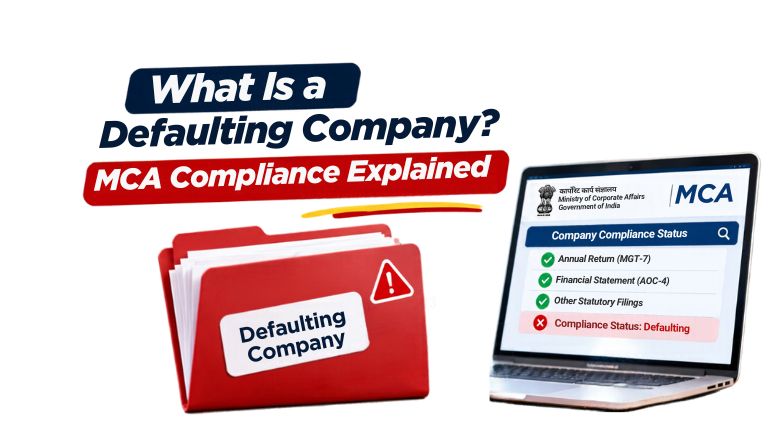
All Indian companies must meet certain statutory compliances as per the Companies Act, 2013 and submit various forms/returns/statements with the Ministry of Corporate Affairs (MCA).
Non-compliance with such statutory obligations may give rise to a company becoming a defaulting company and attract further penalty, fine, restriction on filing with MCA, among other penalties.
In this blog post, we will discuss what is meant by defaulting company, why a company is termed a defaulter, consequences, and how one can regularize their compliance status.
What Is a Defaulting Company?
A defaulting company can be defined as a company that has not made the required statutory filing in time at the ROC.
Examples of such companies would include those that have not filed their annual accounts and annual return for one or more fiscal years.
It should be noted that a company can remain active on the MCA website while being considered a defaulting company.
Why Does a Company Become a Defaulter?
Some common reasons for a company becoming a defaulter are:
1. Non-filing of Financial Statements: Not filing Form AOC-4 or its variations as per the timeline.
2. Non-filing of Annual Return: Not filing the Form MGT-7 or MGT-7A as applicable.
3. Non-compliance with KYC of Directors: The non-compliance with DIR-3 KYC as per the requirements from the directors.
4. Non-filing of Event-based Forms: The non-filing of forms relating to appointment/ resignation of directors, share allocation, charges, change in the registered office, etc.
5. Statutory Compliance Delinquency: Non-compliance with the Companies Act, 2013 for mandatory filing as per the timelines.
Even companies that have not commenced business or have no revenue are generally required to fulfil applicable statutory filing obligations.
Consequences of Being a Defaulting Company
Being classified as a defaulting company can have several consequences:
- Additional Charges: Late filings can incur extra charges, which may be determined on the basis of the duration of delay.
- Barriers to MCA Filings: Some specific forms may not be allowed until all the outstanding annual filings are filed.
- Disqualification of Directors: Continued default in filing accounts or annual returns for three consecutive financial years will lead to disqualification as per Section 164 (2). This is subject to the relevant laws in this regard.
- Making Corporate Transactions Difficult: Non-compliance can cause problems while undertaking mergers, restructuring, investments, and due diligence processes.
- Legal and Regulatory Issues: The company and its directors in default will be liable to penalties and other procedures under the Companies Act.
How to Check Defaulting Status on MCA?
Follow these steps to check the company’s filing status:
Step 1: Visit the official MCA website: https://www.mca.gov.in/
Step 2: Navigate to MCA Services → Master Data → View Company/LLP Master Data.
Step 3: Enter the company’s CIN or name and submit the details.
Step 4: Review the company master data, including the year-wise filing status and details of the latest balance sheet and annual return filed.
Step 5: Check the filing history and identify any pending financial statements, annual returns, or other applicable forms.
This will help identify the financial years for which the company has outstanding compliance requirements.
How to Remove Defaulting Status?
A company can generally regularise its defaulting status by completing the pending statutory compliances.
Step 1: Identify all overdue forms and the financial years for which filings are pending.
Step 2: Prepare the necessary financial statements, annual returns, and supporting documents.
Step 3: Conduct pending AGMs or take appropriate legal action regarding delayed meetings, wherever required.
Step 4: File the outstanding forms, such as AOC-4, MGT-7/MGT-7A, and other applicable forms, along with prescribed fees and additional fees.
Step 5: Verify the updated filing status on the MCA portal and ensure that all outstanding compliances have been completed.
If the company or its directors are subject to disqualification or other legal restrictions, additional procedures may be necessary.
Penalties for Non-Compliance
The penalties depend on the nature of the default and the applicable provision of the Companies Act, 2013.
| Non-Compliance | Possible Consequence |
| Delay in AOC-4 | Additional filing fees and applicable penalties |
| Delay in MGT-7/MGT-7A | Additional filing fees and applicable penalties |
| Non-filing for 3 consecutive financial years | Possible director disqualification under Section 164(2) |
| Non-compliance with other statutory provisions | Penalties under the relevant sections of the Act |
The company should evaluate each default separately because the applicable additional fees and penalties may vary.
FAQs
Q1. Can an active company be a defaulting company?
Yes. A company may have Active status on MCA but still have pending annual returns or financial statements.
Q2. Is ROC filing mandatory if the company has no business?
Yes. Companies are generally required to file annual financial statements and annual returns even if they have not commenced business or generated revenue.
Q3. Can a defaulting company file new MCA forms?
Certain forms may be restricted until overdue annual filings are completed. The applicable restriction depends on the company’s filing status and the form being submitted.
Q4. Can directors be disqualified due to company default?
Yes. Section 164(2) provides for disqualification in specified circumstances, including failure to file financial statements or annual returns for three consecutive financial years.
Q5. How can a company become compliant again?
By identifying all outstanding filings, completing the applicable statutory requirements, and filing pending forms with prescribed and additional fees.
Q6. Is there any special scheme to regularise defaults?
MCA has introduced compliance schemes from time to time, such as the Companies Fresh Start Scheme, 2020. However, such schemes are time-bound. Companies should check whether any applicable scheme is currently available before relying on it.
Conclusion
Companies can have problems if the statutory compliances remain pending when the company has defaulted. Monitoring the MCA account, filing the annual return, and managing corporate documents are some ways through which companies can avoid these defaults.
Periodic reviews and corrective actions in case of necessity will help companies keep themselves compliant.
ALSO READ
How to Check Whether a Company Is Active or Compliant on MCA
NGO Annual Compliance Checklist for Trusts, Societies & Section 8 Companies
Public Limited Company Compliance Calendar – Important ROC Filings
Difference Between Nidhi Company vs Section 8 Micro Finance Company