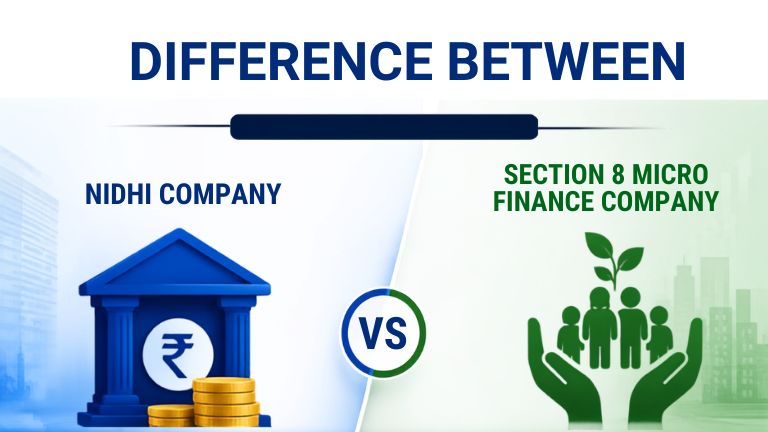
Determining the appropriate legal entity type is arguably the most important decision for a entrepreneur in the finance industry. A lot of people confuse between a Nidhi Company and Section 8 Micro Finance Company as both are financial institution involved in borrowing and lending activities.
But the nature of their legal form, business model, goals, level of compliance and regulatory environment are different. Though the purpose of the Nidhi company is to engage in finance activities among its members, a Section 8 Micro Finance Company is established in promoting social welfare and financial inclusion. Both need to be registered and are regulated under the Companies Act, 2013 but have very different business models, profit intentions and area of operations.
Hence, it is important have a clear understanding of these two before you plan to commence a finance related business in India.
This article contains the full comparison between Nidhi Company and Section 8 Micro Finance Company, in terms of legal provisions, registration procedures, benefits and drawbacks, compliance requirements and real world business applicability.
Meaning of Nidhi Company
A Nidhi Company is a type of Non-Banking Financial Company (NBFC) and the provisions of Companies Act, 2013 that are applicable to the company are also applicable to it & it is subject to the circulars and notifications issued from time to time by the Ministry of Corporate Affairs.
The objectives of Nidhi company is:
- Cultivating savings habits among members,
- Accepting deposits from members, and providing loans only to members.
A Nidhi Company operates on the principle of mutual benefit. It can neither deal with the general public nor conduct large-scale commercial banking activities.
The company must use the words “Nidhi Limited” in its name and comply with strict NDH filing requirements prescribed by the Ministry of Corporate Affairs.
Meaning of Section 8 Micro Finance Company
A Section 8 Company is formed under section 8 of the Companies Act, 2013, with an objects to promote social welfare, financial inclusion, development in rural areas, women empowerment and helping the Weaker economy class section. The main purpose of the Section 8 Company is not to earn profits as opposed to a Nidhi Company but to undertake charitable and developmental activities.
These companies usually provide:
- Small unsecured loans,
- Micro-credit support,
- Self-employment funding,
- Rural financing assistance, and women entrepreneurship support.
Any profits earned by a Section 8 Company must be reinvested into the company’s objectives and cannot be distributed among members or directors.
Legal Framework Governing Both Entities
Nidhi Company
A Nidhi Company is regulated by:
- Companies Act, 2013
- Nidhi Rules, 2014
- MCA notifications and circulars
Although it falls under the NBFC category, RBI has exempted Nidhi Companies from obtaining full NBFC registration for their limited member-based operations.
Section 8 Micro Finance Company
A Section 8 Micro Finance Company is governed by:
- Companies Act, 2013
- MCA Rules and notifications
- Income Tax provisions for charitable organizations
These companies generally operate for non-profit social objectives and may also seek benefits under Sections 12A and 80G of the Income Tax Act.
Objective and Purpose
Objective of Nidhi Company
The main objective is:
- Promoting savings among members,
- Borrowing and lending within members, and running a mutual benefit finance model.
The focus is commercial in nature though restricted to members only.
Objective of Section 8 Micro Finance Company
The primary objective is:
- Financial inclusion,
- Social welfare,
- Poverty reduction,
- Helping low-income communities, and empowering weaker sections.
The focus is developmental and charitable rather than profit-oriented.
Difference Between Nidhi Company and Section 8 Micro Finance Company
| Basis | Nidhi Company | Section 8 Micro Finance Company |
| Governing Law | Companies Act + Nidhi Rules | Section 8 of Companies Act |
| Nature | Mutual Benefit Company | Non-profit Company |
| Main Objective | Member finance activities | Social welfare & financial inclusion |
| Profit Distribution | Allowed among members | Not allowed |
| Loan Facility | Only to members | To eligible beneficiaries/groups |
| Deposit Acceptance | Allowed from members | Not allowed |
| RBI Registration | Exempted | Exempted |
| Members Requirement | Minimum 7 members | Minimum 2 Members |
| Minimum Directors | 3 Directors | 2 Directors |
| Name Requirement | Must use “Nidhi Limited” | No mandatory suffix |
| Tax Benefits | Limited | 12A & 80G benefits possible |
| Area of Operation | Restricted member network | Wider social operations |
| Annual Compliance | Mandatory filing of NDH Forms (NDH-1, NDH-3, etc., as applicable) along with annual ROC filings | Mandatory annual ROC filings, including forms such as AOC-4 and MGT-7/MGT-7A, as applicable |
| Profit Motive | Commercial mutual benefit | Charitable/social purpose |
| Funding Structure | Member deposits | Grants, donations, funding support |
| Share Transfer | Restricted | Controlled as per MOA/AOA |
| Business Scope | Finance among members | Micro-credit & welfare activities |
Detailed Comparative Analysis
1. Nature of Business
A Nidhi Company works like a mutual finance institution where members contribute deposits and receive loans. It is a closed financial system restricted to members only.
On the other hand, a Section 8 Micro Finance Company focuses on helping economically weaker sections by offering financial assistance and developmental support.
2. Profit Motive
Nidhi Companies operate with a profit motive. The profits earned can be distributed among shareholders in the form of dividends.
In contrast, Section 8 Companies cannot distribute profits among members. Any surplus income must be used only for achieving its objectives.
This is one of the biggest practical differences between both structures.
3. Deposit Acceptance
A Nidhi Company can legally accept deposits from its members subject to Nidhi Rules compliance.
However, a Section 8 Micro Finance Company cannot accept public deposits and does not operate as a deposit-taking institution.
4. Lending Activities
Nidhi Companies provide loans only to members and cannot deal with outsiders.
Section 8 Micro Finance Companies may provide micro-credit support to:
- Women groups,
- Self-help groups,
- Rural entrepreneurs, and low-income individuals.
Their operations are wider in social impact.
5. Regulatory Compliance
Nidhi Companies face heavy compliance requirements including:
- NDH-1,
- NDH-2,
- NDH-3,
- NDH-4,
- Annual ROC filings,
- Ratio maintenance,
- Member compliance,
- Deposit compliance.
Section 8 Companies also have compliance obligations but comparatively fewer operational restrictions related to deposits and members.
6. Minimum Members Requirement
A Nidhi Company must achieve:
- Minimum 200 members,
- Net Owned Funds requirements,
- Prescribed deposit ratios.
Failure may lead to penalties and restrictions.
A Section 8 Company does not have such strict member requirements.
7. Tax Benefits
Nidhi Companies do not enjoy major tax exemptions.
Section 8 Companies may obtain:
- 12A registration,
- 80G Registration,
- Eligibility for grants and funding.
It is for this reason Section 8 companies are vested well with charitable organisations and NGOs.
8. Public Image and Credibility
Nidhi Companies are viewed as member-based finance entities.
Section 8 Companies often enjoy better social credibility because they operate for charitable and developmental purposes.
Many donors, CSR programs, and welfare schemes prefer working with Section 8 entities.
9. Operational Restrictions
Nidhi Companies cannot:
- Advertise deposits,
- Deal with outsiders,
- Engage in chit funds,
- Issue preference shares, or conduct large-scale banking business.
Section 8 Companies also face restrictions but enjoy more operational flexibility for social projects
10. Appropriate Business Model
Choose a Nidhi Company if:
- You want a member-based finance business,
- Savings and lending operations,
- Profit-oriented structure,
- Local finance model.
Choose a Section 8 Micro Finance Company if:
- You want NGO-style operations,
- Social finance activities,
- Rural development projects,
- Financial inclusion initiatives,
- Women empowerment programs.
Advantages of Nidhi Company
- Compared to full NBFC registration, Nidhi incorporation is comparatively easier.
- Nidhi Companies can accept deposits from members legally.
- It encourages savings and financial discipline among members.
- RBI regulations are comparatively relaxed for Nidhi Companies.
- Profits can be distributed among shareholders.
Advantages of Section 8 Micro Finance Company
- Section 8 entities are highly trusted for welfare activities.
- Eligible for multiple tax exemptions and donor advantages.
- Can receive grants, CSR funding, and donations.
- Suitable for poverty reduction and community development.
- The focus remains on long-term social development.
Regulatory Constraints and Compliance
Both entities must comply with MCA regulations. Non-compliance may result in:
- Penalties,
- Disqualification of directors,
- Cancellation of registration,
- Legal notices,
- Operational restrictions.
Therefore, professional compliance management becomes extremely important.
Why Choose My Legal Business LLP?
- Choice of the financial business form We can guide you fully on the selection of the appropriate financial business form.
- We facilitate documentation, formation, licensing, compliance and regulatory clearances.
- We take all necessary steps and follow the correct procedure to make sure your ROC filings and regulatory compliance are in place and you don’t attract any penalties.
- We offer clear, affordable legal advice for startups and financial firms.
- Each business is unique. We offer customized legal advice based on your goals and business model.
- We focus on smooth incorporation and timely completion of legal formalities.
Conclusion
Nidhi Company and Section 8 Micro Finance Company both belong to financial sector but serve entirely different functions. A Nidhi Company is suitable for carrying on the business of borrowing and lending money among members with a profit motive, whereas a Section 8 Micro Finance Company is engaged in social welfare, financial inclusion or other development activities without distributing profits. Which of the two is best for you will depend on you business goals, revenue model, targeted users and vision. Businessmen who want commercial finance operation may choose Nidhi Company so the Section 8 turnover good option for companies that are focused on the community support and not-for-profit. Before you go with any structure, you must get adequate legal advice and plan for compliance in order to prevent legal mess in the future.
FAQs
1.Is a Nidhi Company NBFC?
Yes, but a Nidhi Company is a non-banking financial company, but it has been exempted by RBI from complying with RBI Norms.
2. Whether a Section 8 company can declare dividends?
No, A Section 8 company is prohibited from disbursing profits to its members or directors. All its earned should be directed toward social causes.
3. Can a Nidhi Company take Deposits from public?
No. It takes deposit only from its members, and not from the public.
4. Which is the Best Company for Microfinance business?
Generally, a Section 8 Micro Finance Company is better for social micro-finance and welfare-based lending practices.
5. Whether RBI approval required for a Nidhi Company?
No, RBI approval is not required as Nidhi Companies are exempt from core RBI provisions relating to NBFC registration.
6. Can a Section 8 Company give loans?
Yes. It may provide micro-credit and financial assistance for welfare objectives subject to applicable laws.
7. Which structure has more compliance requirements?
Nidhi Companies generally have stricter operational compliances due to deposit and member regulations.
8. Can a Nidhi Company work across India?
Nidhi Company can operate only within the district where its registered office is situated.
9. Can Nidhi Companies get tax exemptions?
In general, Nidhi Companies are not eligible for the larger charitable tax exemptions.
10. Can a Section 8 Micro Finance Company distribute profits to its members?
A Section 8 Micro Finance Company must apply its profits or income solely towards promoting its stated charitable or social objectives.
ALSO READ
Complete Step-by-Step Guide for Closing a Nidhi Company
Section 8 Microfinance Company Registration- A complete guide
How to Increase Authorized Share Capital of a Company
Difference Between AOC-4 and MGT-7 in Annual Filing
Step-By-Step Process of NSIC Registration
NGO Registration for Women Empowerment in India