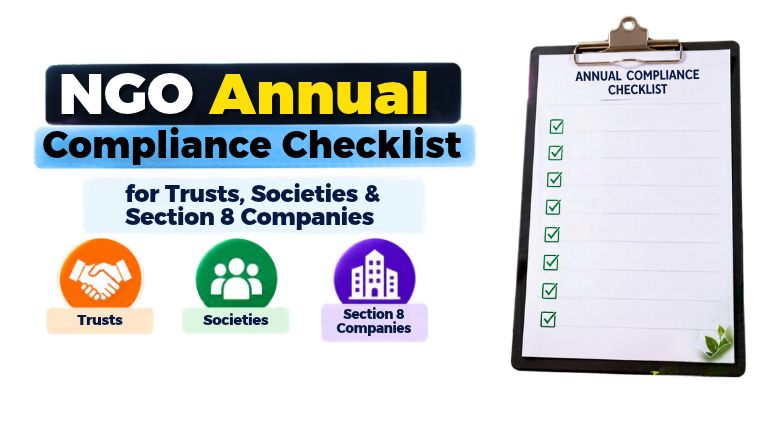
NGOs are vital in India when it comes to education, healthcare, environmental conservation, social welfare, and charity work. The NGO has to comply with certain legal and other requirements every year, these vary with the type of the NGO [Trust, Society, or Section 8 Company].
Annual compliance for an NGO is important to help keep an NGO legally compliant, maintain tax exemptions, continue to receive government grants and CSR funds, and to build credibility with the stakeholders.
This compliance checklist contains everything you need to know about annual compliance for Trusts, Societies and Section 8 Companies.
What is an NGO?
An NGO is a non-governmental organization and typically is a non-profit organization which is an entity that is recognized as a society, trust, or a section 8 company that is formed for various activities like religious, social, educational, scientific cultural activities and more for the welfare of the public without the intent of earning profits and it can be considered as an NGO. Generally, Indian NGOs are registered under:
- Public Charitable Trusts
- Societies
- Section 8 Companies
Classification of NGOs in India
1. Trust
A trust may be registered under the Indian Trust Act, 1882 (private trust) or the relevant State Public Trust Act if any.
2. Society
Under the Societies Registration Act, 1860 or the appropriate State Societies Registration Act, they register a society.
3. Section 8 Company
A section 8 company means a company registered under section 8 of the Companies Act, 2013 whose objects are charitable.
Legal Regulations for NGO Compliance
Depending on the category of the NGO, the following are a few among the annual legal compliances:
- Companies Act, 2013 (for Section 8 Companies)
- Income-tax Act, 1961
- Societies Registration Act, 1860
- Indian Trusts Act, 1882 and applicable State Trust Acts
- Foreign Contribution (Regulation) Act, 2010 (FCRA) (where applicable)
Importance of annual compliance
Annual compliance assists NGOs in:
- Maintain legal recognition.
- Continue tax exemption benefits.
- Keep the donor confident.
- Remain eligible for CSR funds.
- Stay away from legal issues.
- Remain transparent and accountable.
Compliance Checklist for Trusts
Trusts should generally ensure:
- Maintenance of proper books of accounts.
- Preparation of annual financial statements.
- Filing of Income Tax Return.
- Filing of audit report (where applicable).
- Renewal or compliance under 12AB and 80G, where applicable.
- FCRA annual return (if registered under FCRA).
- GST return filing (if registered).
- Renewal of registrations under applicable State laws, if required.
Compliance Checklist for Societies
Societies generally need to comply with:
- Annual General Meeting
- Maintenance of statutory records.
- Filing of annual list of governing body/members with the Registrar, as required under the applicable State law.
- Preparation of financial statements.
- Income Tax Return filing.
- Audit of accounts, where applicable.
- 12AB and 80G compliances.
- FCRA annual return, if applicable.
- GST compliance, if registered.
Compliance Checklist for Section 8 Companies
While Section 8 companies are required to follow the Companies Act, 2013 which inter alia includes:
- Convening of Board Meetings.
- Holding the Annual General Meeting (AGM).
- Maintaining statutory registers and minutes.
- Preparation of financial statements.
- Appointment of Auditor (where applicable).
- Filing Form AOC-4 (Financial Statements).
- Filing Form MGT-7 (Annual Return)
- Income Tax Return filing.
- Filing DIR-3 KYC (where applicable for directors).
- Filing DPT-3, MSME Form I, BEN-2, or other applicable MCA forms, where required.
- GST compliance, if registered.
- FCRA annual return, if applicable.
General Compliance Applicable to All NGOs
Regardless of the legal structure, NGOs should ensure:
- Proper bookkeeping.
- Timely Income Tax Return filing.
- Audit of accounts, where applicable.
- Renewal and compliance under 12AB and 80G.
- GST return filing, if applicable.
- TDS compliance, where applicable.
- FCRA compliance (if receiving foreign contributions).
- Timely renewal of licences and registrations.
- Maintenance of records of donations and utilization of funds.
Consequences of non-compliance
Sanctions for non-Compliance may be:
- Penalties under applicable laws.
- Cancellation of registrations.
- Loss of tax exemption benefits.
- Suspension or cancellation of FCRA registration.
- MCA penalties (for Section 8 Companies).
- Legal action by regulatory authorities.
- Lack of trust of donors and stakeholders.
Mistakes to be Avoided
- Missing annual filing deadlines.
- Failure to maintain proper books of accounts.
- Delayed filing of Income Tax Returns.
- Ignoring MCA filing requirements.
- Non-renewal of 12AB or 80G registration.
- Incorrect utilization or reporting of foreign contributions.
- Poor maintenance of statutory records.
Why to Choose My Legal Business LLP?
At My Legal Business LLP, we provide complete NGO compliance and advisory services, including:
- Trust Registration
- Society Registration
- Section 8 Company Incorporation
- Annual MCA Compliance
- Income Tax Return Filing
- 12AB & 80G Registration and Renewal
- FCRA Registration and Annual Return Filing
- GST Registration and Compliance
- Accounting, Audit Coordination, and Secretarial Compliance
Our experienced team makes sure that your NGO is in full compliance with Companies Act, 2013, Income-tax Act, 1961, FCRA, 2010 and other applicable laws.
Conclusion
Annual compliance is mandatory for all trusts, societies and section 8 companies, if they wish to retain its status as a legal entity, availing tax benefits and they need to keep the operation transparent. Compliance with provisions of the Corporations Act 2013, the Income Tax Act 1961, Societies Registration Act, 1860, state trust legislations and FCRA, 2010 or the relevant law applicable in your jurisdiction enables the NGO to function legally without hindrance.
Frequently Asked Questions (FAQs)
Is yearly compliance compulsory for an NGO?
Yes, Every NGO is bound to do the Annual Return filings applicable to its legal Form and Registrations.
Which act governs for Section 8 Company?
The Companies Act, 2013 applies to a section 8 company.
Are NGOs required to file a return for Income Tax?
Yes, NGOs are required to file Income-tax Returns under the Income Tax Act, 1961.
What are the MCA forms generally filed by Section 8 Company?
Section 8 companies -AOC-4 and MGT-7 usually file.
Is audit necessary for all NGOs?
This depends on various parameters including laws and thresholds applicable under such laws.
What is 12AB registration?
No. Registration under Section 12AB of the Income-tax Act permits qualified charitable institutions to get tax exempt status under certain conditions.
Is 80G registration mandatory?
Yes. Registration under Section 80G permits eligible contributors to obtain tax deduction on their contributions under the Income-tax Act.
When is FCRA compliance required?
An NGO is required to comply with FCRA in the event it receives foreign contributions under the Foreign Contribution (Regulation) Act, 2010.
Can a Section 8 Company receive CSR funds?
Yes. Qualified Section 8 Companies can be funded by CSR funds under the Companies Act, 2013 and CSR norms.
10. What is the consequence of an NGO not doing its annual compliance?
Default will attract fines, deregistration, removal of tax-benefits, prosecutions, and reputation impairment.
ALSO READ
Guide to Filing ITR for Salaried Employees in India
How to Apply for FSSAI License Registration in India
ITR Filing For Founders & Startups