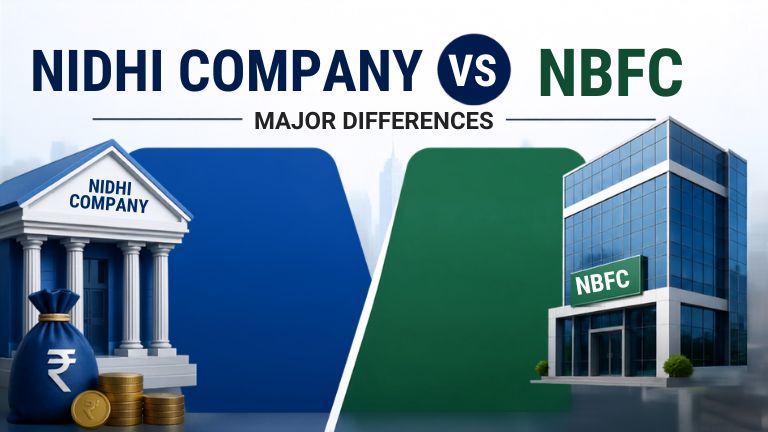
The Indian financial system provides the many avenues for raising, borrowing and the provision of financial services. Including Nidhi Companies and Non-Banking Financial Companies (NBFCs) are among some of the structures that receive the most air time. Though they are two types of financial institutions, they are vastly different in terms of legal status, scope of activities, RBI regulations, capital requirements and business flexibility. People thinks wrongly about what Nidhi Company and NBFC are the same as they deal in loan and deposit. But Nidhi operates on a model of mutual benefits with a closed door (members only) business and NBFC is professionally regulated financial institution which provides more financial services to the public. It is vital to know the difference between these two before you start any business related to finance as an incorrect choice would mean facing compliance chaos, operational restrictions and regulatory headaches. In this article we are going to learn full difference between Nidhi company vs NBFC including the process of registration, legal framework, powers to do business, compliance requirement, benefits and feasibility in practical scenario.
Meaning of Nidhi Company
A Nidhi Company is a type of company incorporated under Section 406 of the Companies Act, 2013 and governed by Nidhi Rules, 2014.
Its primary objective is:
- Promoting savings among members,
- Accepting deposits from members, and providing loans only to members.
A Nidhi Company works on the principle of mutual benefit and can deal only with its members. It cannot conduct large-scale commercial banking or public finance activities.
The company must use the words “Nidhi Limited” in its name and comply with NDH filing requirements prescribed by the Ministry of Corporate Affairs.
Meaning of NBFC
An NBFC (Non-Banking Financial Company) is a financial institution registered under the Companies Act and regulated primarily by the Reserve Bank of India.
NBFCs offer multiple financial services, including:
- Loans and advances,
- Asset financing,
- Investment services,
- Microfinance,
- Leasing,
- Hire purchase,
- Housing finance, and wealth management.
NBFCs are not allowed to issue cheques drawn on themselves unlike banks but they can do multi-crore financial business with the public on obtaining RBI permission.
Applicable Laws governing Both Entities
Nidhi Company
Nidhi Companies are governed by:
- Companies Act, 2013
- Nidhi Rules, 2014
- MCA notifications and circulars
Although categorized under NBFCs, they enjoy limited RBI exemptions due to their restricted member-based operations.
NBFC
NBFCs are governed by:
- Companies Act, 2013
- RBI Act, 1934
- RBI Master Directions
- Various financial regulations and circulars
NBFCs are directly supervised and regulated by RBI.
Objective and Nature of Business
Objective of Nidhi Company
The objective is:
- Mutual savings,
- Member-based lending, and promoting thrift among members.
Its operations remain limited within members only.
Objective of NBFC
The objective of an NBFC is:
- Commercial financial services,
- Lending and investment activities, and large-scale financial operations.
NBFCs are profit-oriented institutions serving broader public and corporate sectors.
Nidhi Company Vs NBFC – Major Differences
| Basis | Nidhi Company | NBFC |
| Governing Authority | MCA | RBI + MCA |
| Registration Requirement | Simple incorporation | RBI License mandatory |
| Main Law | Nidhi Rules, 2014 | RBI Act, 1934 |
| Main Objective | Mutual benefit among members | Commercial finance activities |
| Public Dealing | Not allowed | Allowed |
| Deposits | From members only | Public deposits subject to RBI approval |
| Loan Facility | Only to members | To public, businesses, and institutions |
| RBI Approval | Not required | Mandatory |
| Minimum Capital | Lower capital requirement | ₹10 Crore NOF generally required |
| Area of Operation | Within district only | Nationwide operations |
| Profit Model | Limited mutual benefit | Large-scale commercial profit |
| Financial Services | Basic lending and deposits | Wide range of financial services |
| Regulatory Burden | Moderate | Very high |
| Compliance Forms | NDH Forms | RBI returns and compliances |
| Risk Level | Comparatively lower | Higher due to public exposure |
| Foreign Investment | Restricted | Allowed subject to RBI/FDI norms |
| Branch Expansion | Restricted | Easier with approvals |
| Credibility | Local/community level | Higher institutional credibility |
Detailed Comparative Analysis
Regulatory Authority
The major difference is in the regulation. Nidhi Companies are primarily governed by the Ministry of Corporate Affairs RBI involvement is minimal because Nidhi Companies operate only among members.
NBFCs, however, are strictly regulated by RBI because they deal with public money and broader financial markets.
This makes NBFC compliance much stricter.
Registration Process
A Nidhi Company can be incorporated like a normal public company with comparatively simple compliance requirements.
An NBFC requires:
- Company incorporation,
- RBI application,
- Net Owned Fund requirement,
- Background verification,
- Business plan approval, and extensive scrutiny.
NBFC registration is significantly more complex and time-consuming.
Minimum Capital Requirement
Nidhi Companies have comparatively lower capital requirements.
NBFCs generally require:
- Minimum ₹10 Crore Net Owned Funds (for most categories),
- Proper financial infrastructure,
- Strong compliance systems.
This makes NBFC incorporation more expensive.
Deposit Acceptance
A Nidhi company is allowed to take deposits only from its members.
An NBFC can accept deposits from the public only with prior approval of the RBI and after compliance of certain conditions.
This is why NBFCs are more heavily monitored.
Lending Powers
Nidhi Companies can provide loans only to members.
NBFCs can provide loans to:
- Individuals,
- Businesses,
- Corporates,
- MSMEs,
- Startups, and institutions.
Their operational scope is much wider.
Business Flexibility
Nidhi Companies face several operational restrictions such as:
- No chit fund business,
- No leasing,
- No insurance business,
- No securities trading,
- No public dealing.
NBFCs can engage in multiple sophisticated financial activities depending upon their license category.
Compliance Burden
Nidhi Companies mainly file:
- NDH-1,
- NDH-2,
- NDH-3,
- NDH-4,
- ROC annual returns.
NBFCs must comply with:
- RBI reporting,
- Statutory audits,
- Capital adequacy norms,
- KYC norms,
- FIU reporting,
- AML compliance, and regular inspections.
NBFC compliance is significantly more complex.
Risk and Regulation
Since NBFCs handle public funds and large financial transactions, regulatory scrutiny is extremely high.
Nidhi Companies usually operate on a smaller community-based level and therefore face comparatively lower systemic risk.
Public Credibility
NBFCs generally enjoy higher institutional credibility because they are directly regulated by RBI.
Nidhi Companies are mostly preferred for localized member finance systems.
Suitable Business Model
Choose Nidhi Company if:
- You want community finance business,
- Member-based deposits and lending,
- Lower compliance burden,
- Smaller operational scale.
Choose NBFC if:
- You want large-scale finance business,
- Public lending operations,
- Institutional funding,
- Broader financial services,
- Higher scalability.
Advantages of Nidhi Company
- Registration is simpler compared to NBFC licensing.
- Compliance burden is moderate.
- Suitable for small finance entrepreneurs.
- No full RBI registration generally required.
- Promotes local savings and financial support.
Advantages of NBFC
- NBFCs can provide diversified financial services.
- RBI regulation increases public trust.
- NBFCs can attract institutional investments and funding.
- Operations can expand nationwide.
- Perfect for scalable and large company finance models.
Compliance and Regulatory Restrictions
Both structures must comply with applicable laws. Failure to comply could lead to:
- Heavy penalties,
- Cancellation of registration,
- Director disqualification,
- RBI action,
- Legal proceedings.
Hence, professional management between legal and compliance is key.
Important Factors to consider Before Choosing
Before choosing a structure, consider:
- Capital availability,
- Target customers,
- Operational scale,
- Compliance capability,
- Funding requirements,
- Future expansion plans,
- Regulatory readiness.
Selecting the appropriate entity at the start will prevent you from encountering legal and operational troubles down the line.
Why Choose My Legal Business LLP?
- Our professionals help you choose the most suitable financial business structure.
- We provide end-to-end support for Nidhi Company and NBFC registration processes.
- We ensure smooth ROC and RBI compliance management.
- Transparent pricing with professional support throughout the process.
Conclusion
Nidhi Company vs NBFC seems to be similar as both deal in financial activities but in reality, they differ to large extent when it comes to their regulation, operational scope, required capital, compliance requirements and the flexibilities of conducting business. A Nidhi Company is for localized member-based finance operations with an average level of compliance requirements, whereas an NBFC can be used for providing large scale commercial financial services regulated by RBI. They need to think through their business objectives, financial strength, compliance preparedness, and long-term growth plans prior to choosing the structure. The right legal advice can prevent what might otherwise be a compliance and regulatory nightmare down the road.
FAQs
1.Is Nidhi Company an NBFC?
Yes. Nidhi Company is classified as a Non-Banking Financial Company (NBFC), but it is exempted of certain act by the RBI as it is a member based company.
2. Does Nidhi Company need to be registered with RBI?
As a rule, separate rbi registration is not required for Nidhi relating to their ordinary course of business.
3. Can NBFCs take public deposits?
Yes, they can, if they have got the permission from RBI after meeting the various conditions.
4. Which has higher compliance requirements?
Compliance on NBFCs is way more because they are directly regulated by RBI.
5. Can Nidhi Company lend to public?
No, only to the members of the company Nidhi company can lend.
6. What is the minimum capital requirement for NBFC?
The NOF requirement of 10 Crore is applicable under general case to most categories of NBFC.
7. Which structure is better to start?
To Incorporate a Nidhi Company is relatively simple and less expensive than that of an NBFC.
8. Which structure has wider business scope?
NBFCs have a much broader operational and financial services scope.
9. Can foreign investment be received in a Nidhi Company?
Foreign investment opportunities are limited compared to NBFC structures.
10.Which structure is more suitable for large business of lending?
NBFC is mostly appropriate for large scale money lending and business financing.
ALSO READ
Difference Between Nidhi Company vs Section 8 Micro Finance Company
Complete Step-by-Step Guide for Closing a Nidhi Company
Maximum Number of Directorships Allowed Under the Companies Act, 2013
Difference Between Nidhi Company vs Section 8 Micro Finance Company
Can a Private Limited Company Take Loans from Directors
Penalties for Non-Compliance in a Private Limited Company
Annual Compliance for Private Limited Company
Difference between Company Limited by Shares and Company Limited by Guarantee