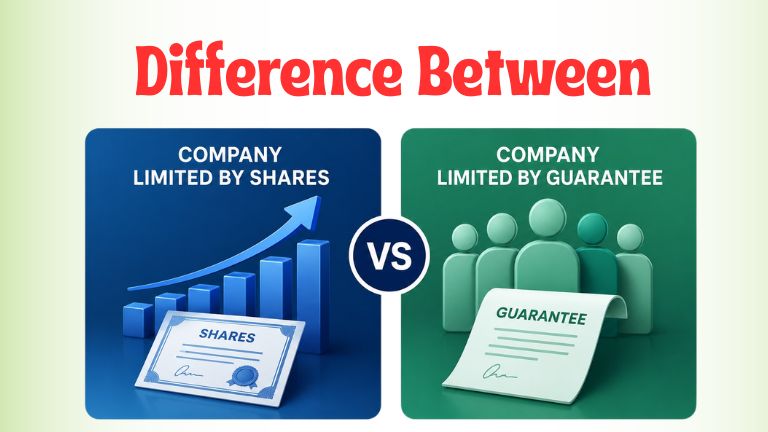
When starting a new business in India, choosing between Company Limited by Shares and Company Limited by Guarantee is one of the most important decisions an entrepreneur needs to make.
The main distinctions between Company Limited by Shares and Company Limited by Guarantee are found in its objectives, funding sources and methods of profit management. You need to understand the distinctions in order to make the best choice for your future goals.
A Company Limited by Shares is designed for companies that want to make money and expand alongside investors. Members’ risk is restricted to the outstanding balance on the shares they own.
Without any share capital, a Company Limited by Guarantee operates. Members merely promise to pay a limited, predetermined amount in the event that the business closes. Charities, clubs, social organizations, and non-profits are the main uses for it. Selecting the appropriate structure is crucial to preventing subsequent issues with funding, taxes, and compliance.
In this blog, we shall walk you through the idea of Company Limited by Shares Vs. Company Limited by Guarantee along with their advantages and disadvantages and the right manner to choose between Company Limited by Shares Vs. Company Limited by Guarantee.
What is a Company Limited by Shares?
In India, a firm Limited by Shares is a common corporate structure where the firm is regarded as an independent legal entity. It is able to enter into contracts, hold property, and file or defend lawsuits in its own name. Its primary characteristic is that it uses share capital and strives for profit.
Members or shareholders are only liable for the outstanding balance on their shares. In the event that the business incurs losses or obligations, their personal assets remain secure.
Private limited corporations are not allowed to invite public investment and can only have 200 members. Public limited corporations have no cap on the number of shareholders and can raise money from the general public.
The majority of trading firms, tech companies, and startups select this format. Numerous well-known private limited enterprises in the manufacturing and e-commerce industries are examples.
To raise funds, the corporation offers shares. When profits are distributed, shareholders who own a portion of the business are eligible to receive dividends.
This framework limits personal risk while providing flexibility for expansion.
What is a Company Limited by Guarantee?
Here is a clear and simple explanation that every founder or social worker should understand.
In India, a unique kind of business with no share capital is a Company Limited by Guarantee. It was established as a distinct legal entity primarily for nonprofit objectives. Members pledge to help the business out if necessary.
In the event that the business fails due to debt, each member pledges to pay a predetermined small sum (the guarantee). Typically, this ranges from Rs 100 to Rs 10,000. Beyond this threshold, personal assets are still protected.
There are no shares or stockholders. People become members by accepting the assurance and signing the memorandum. According to the organization’s policies, membership may change.
Charities, non-governmental organizations, professional groups, sports teams, and trade associations that don’t give their members a cut of the earnings are the best candidates for it.
This framework keeps everything transparent and lawful while facilitating social and nonprofit action.
Key Differences: Company Limited by Shares Vs. Company Limited by Guarantee
Understanding the difference between Company Limited by Shares Vs. Company Limited by Guarantee is essential for choosing the right business structure based on your financial goals and organizational purpose.
| Basis | Company Limited by Shares | Company Limited by Guarantee |
| Members’ Liability | The liability of members is limited to the unpaid amount on shares held | The liability of members is Limited to the guaranteed amount, payable only at winding up |
| Presence of Share Capital | It has share capital | Generally, it does not have share capital |
| Funding Model | Under this structure, funds are raised through investors, loans, and issue of shares | Under this structure, Funds raised through donations, grants, subscriptions, and membership fees |
| Profit Motive | Primarily profit-oriented | Usually non-profit or philanthropic |
| Profit Distribution | Profits distributed as dividends to shareholders | No dividend distribution; profits are reinvested |
| Ownership Structure | Ownership based on shareholding | No ownership in terms of shares; members act as guarantors |
| Transferability | Shares can be transferred (subject to restrictions) | Membership is generally non-transferable |
| Voting Rights | Voting power based on number of shares held | Typically one member, one vote |
| Typical Uses | Startups, businesses, private/public companies | NGOs, clubs, associations, Section 8 companies |
| Tax Treatment | Taxed as a regular business entity | May avail tax exemptions if registered as a non-profit (subject to conditions) |
| Compliance Requirements | Regular ROC filings and corporate compliances | ROC filings plus additional compliance for non-profit status (if applicable) |
| Winding Up | Remaining assets distributed among shareholders | Members contribute guaranteed amount; surplus transferred to similar entity |
| Risk Exposure | Risk limited to investment in shares | Minimal risk; liability arises only on winding up |
| Conversion Possibility | Can be converted with legal approvals | Conversion possible but complex and less common |
The choice between Company Limited by Shares Vs. Company Limited by Guarantee ultimately depends on whether your focus is profit generation or pursuing non-profit and charitable objectives.
Advantages: Company Limited by Shares Vs. Company Limited by Guarantee
| Basis | Company Limited by Shares | Company Limited by Guarantee |
| Ability to Raise Capital | Under this structure, it is easy to raise funds from investors through equity participation | Under this structure, funds are raised through donations, grants, and CSR contributions. |
| Profit Potential | Under this structure, there is high profit potential with dividend distribution to shareholders | Under this structure, there is no provision for profit distribution & funds are used for charitable or social objectives. |
| Ownership Flexibility | Under this structure, shares are transferable, allowing easy change in ownership | Under this structure, there is a stable structure with no shares, hence there is no ownership dilution. |
| Business Growth | This structure is more suitable for scalability and rapid business expansion | This structure is best suited for long-term philanthropic or humanitarian activities |
| Investor Attraction | This structure attracts investors due to return on investment | This structure attracts institutions, donors, and CSR funding for social impact |
| Liability | Under this structure, there is limited liability to unpaid share capital | Under this structure, liability is limited to guaranteed amount. |
Disadvantages: Company Limited by Shares Vs. Company Limited by Guarantee
| Basis | Company Limited by Shares | Company Limited by Guarantee |
| Compliance Burden | Under this structure, there is increased obligations for compliance and regulations | Additional compliance (e.g., Section 8 requirements if registered as a non-profit) |
| Profit Push | There is continuous pressure to generate profits and returns | Companies under this structure cannot distribute profits/revenue to members |
| Ownership Dilution | Under this structure, issuing new shares reduces control of existing shareholders | Under this structure, there is no ownership stake, which may reduce member incentives |
| Taxation | Companies under this structure are fully taxable as a business entity | Tax benefits available, but subject to strict conditions |
| Funding | Under this structure, there is easier access to funding based on market and investor interest | Under this structure, there is limited equity funding and it depends on grants and donations |
| Concluding Complexity | Distribution of assets among shareholders can be complex | Surplus must be transferred to a similar entity; cannot be distributed |
Choosing the right structure: Company Limited by Shares Vs. Company Limited by Guarantee
When to choose the Company Limited by Shares?
The companies limited by Shares is perfectly suited for startups and profit-driven businesses looking to grow, scale and attract investors. If your goals are to raise cash through equity, give investors returns, and build a profitable firm, a company limited by shares is the best option. It also allows for ownership flexibility, which makes it easier to add more shareholders as the business expands.
When to choose the Company Limited by Guarantee?
A company limited by guarantee is very beneficial to mission-driven organizations like NGOs, charities, and non-profits. If your objective is to have a beneficial social impact instead of making money, this structure is perfect. It helps you to build credibility while raising money through grants, donations, and CSR contributions.
Factors to Consider Before Registration
- Purpose of the Entity
- Funding Requirements
- Control and Ownership
- Compliance and Regulatory Burden
- Cost of Formation and Maintenance
- Taxation and Benefits
- Profit Distribution Intent
- Scalability and Growth Plans
- Credibility and Public Perception
- Exit and Winding-Up Flexibility
Conclusion: Company Limited by Shares Vs. Company Limited by Guarantee
For an entrepreneur, choosing between a Company Limited by Shares Vs. Company Limited by Guarantee is a strategic decision to align with his long-term vision. If the goal is generation of profit, scalability, and investor engagement, a company limited by shares is ideal choice because it provides flexibility in ownership and access to cash. However, companies limited by guarantee are best suited for non-profit, charitable, and mission-driven firms where the focus is on social impact and reinvestment of surplus rather than profit distribution.
Entrepreneurs shall evaluate their operating goals, control preferences, and financial requirements before registering according to their different legal, financial and compliance ramifications.
Our professional team at My Legal Business LLP can help you with end-to-end company incorporation, compliance, and advising services if you’re not sure which structure best suits your needs. We guarantee a seamless and hassle-free establishment customized to your goals, from choosing the appropriate structure to managing ROC filings and legal documentation.
ALSO READ
Sweat equity shares under the Companies Act, 2013
Issue of Bonus Shares in a Private Limited Company
Dematerialization of Shares for Non-small Private Companies
How to Claim Shares from IEPF Step-by-Step Guide