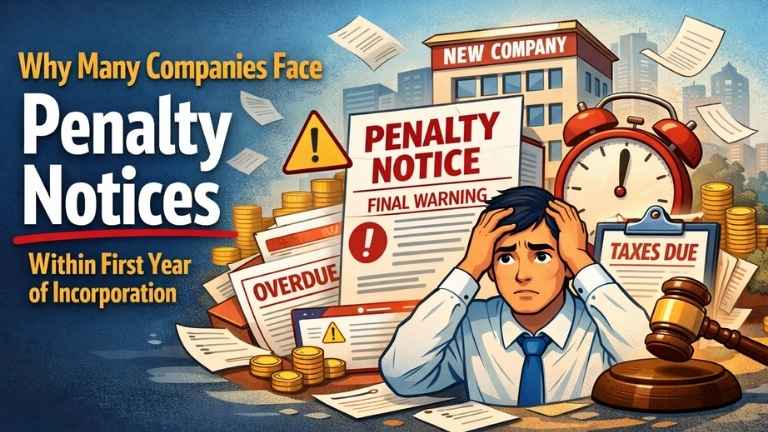
Incorporation is just the beginning not the end of legal formalities.
Whether a Private Limited Company, OPC or Small Company, each entity is required to comply with the laws from the date of its incorporation. The first 12 months are crucial because:
- Regulatory filings commence right away
- Need to establish board governance
- Timelines for financial reports are in force
- Compliances are triggered automatically by events
To miss just one of the requirements is to risk heavy fines, director disqualification and prosecution.
Post-Incorporation Compliance Filing Deadlines
After incorporation, the companies are required to fulfil the following:
- First Auditor Appointment (within 30 days)
- Opening of bank account
- Issue of Share Certificates (within 60 days)
- Filing of Commencement of Business (INC-20A)
- Maintenance of statutory registers
- Disclosure of interest by directors (MBP-1)
- Holding first Board Meeting (within 30 days)
Mostly founders think compliance starts at the end of the year but it starts immediately after incorporation
Most Common reason Companies Receive Penalties notice
1.Non- Filing of INC-20 A (Commencement of Business)
Penalty is attracted if a company having share capital fails to file INC-20A within 180 days from the date of its incorporation.
Penalty:
- ₹50,000 on company
- ₹1,000 per day on officers (whether or not they are in a post, limited to rupees one lacs)
A lot of startups delay capital infusion and forget this filing.
2. Non-Appointment of First Auditor
Under the Companies Act, 2013, the first auditor is required to be appointed within 30 days from the date of registration of the company.
Section 139 provides for consequences of non-appointment of the auditor:
- Penalty on company
- Annual filing → regulatory scrutiny
3. Delay in Annual Filing (Even If No Business)
Even if the company has:
• No turnover
• No transactions
• No profit
It is still mandatory to file annual compliance forms with the Ministry of Corporate Affairs (MCA).
To be filed:
- AOC-4 (Financial Statements) – under Section 137 of the Companies Act, 2013
- MGT-7 / MGT-7A (Annual Return) – under Section 92 of the Companies Act, 2013
If a company does not file with the MCA, the MCA system automatically sends reminders and marks the company as “defaulting”.
Penalties & Late Fees for Non-Filing
1. AOC-4 (Financial Statements)
Late Filing Fee:
₹100 per day (No maximum limit)
Penalty (Section 137):
- Company: ₹10,000 + ₹100 per day (Max ₹2,00,000)
- MD/CFO/Director: ₹10,000 + ₹100 per day (Max ₹50,000 each)
2. MGT-7 / MGT-7A (Annual Return)
Late Filing Fee:
₹100 per day (No maximum limit)
Penalty (Section 92):
- Company: ₹10,000 + ₹100 per day (Max ₹2,00,000)
- Officers in default: ₹10,000 + ₹100 per day (Max ₹50,000 each)
4. Non-Maintenance of Statutory Registers
Companies are required to keep:
- Register of Members
- Register of Directors
- Register of Charges
- Board and General Meeting Minutes
Non-compliance is punishable under section 88 & 118.
5. Ignoring Board Meetings
Minimum:
- 4 Board Meetings annually (for most companies)
- Gap not exceeding 120 days
Many startups operate informally without recording minutes.
6. Incorrect Share Capital Reporting
Founders tend to:
- Long delay between application for and delivery of share certificates
- Under-report the amount of fully paid-up capital
- Neglect to pay stamp duty on share certificates
This results in penalties and complications in future due diligence.
7.Non-Compliance of KYC for Directors (DIR-3 KYC)
Every Director holding a DIN is mandated to file DIR-3 KYC on an annual basis.
Non-filing leads to: –
- DIN deactivation
- Late fee of ₹5,000
8.Non-compliance of GST and other regulations
If registered under GST:
- Monthly/Quarterly returns are mandatory
- Even if there is no turnover, nil return is compulsory.
If the GST return is not filed, the GSTIN will be blocked and penalties will be imposed.
Penalties for Previous Year Default
| Non-Compliance | Section | Penalty Impact |
| Non-filing INC-20A | Sec 10A | ₹50,000 + daily penalty |
| No Auditor Appointment | Sec 139 | Company + officer penalty |
| Delay in AOC-4 | Sec 137 | ₹100 per day |
| Delay in MGT-7 | Sec 92 | ₹100 per day |
| No Board Meetings | Sec 173 | Monetary penalty |
| No Statutory Registers | Sec 88 | Fine on company |
MCA’s compliance system is automated. Even one missed form triggers notice.
Actual compliance errors startups make
❌ “We have not yet started our business, so there is no need to file anything.”
A lot of founders think compliance starts when you start making money. But the statutory filings and compliance need to be done from beginning i.e., date of incorporation as per Companies Act even if there company has no trades, no turnover.
❌ “CA will remind us.”
The directors can avail the services of professionals to assist them, but at the end of the day it is their responsibility to comply as “officers in default”. Not having the right documents or miscommunication or delays in exchanging them can also result in fines.
❌ “Small companies are exempt.”
Certain relaxations are given to small companies in procedures like less number of Board Meeting etc but they are not exempted from filing with ROC or from getting their accounts audited or maintaining statutory records.
❌ “Penalty will be small.”
The penalties used to be compounded and disinserted, while now they are for the most part fixed, automatic and computed for each day of delay this means that even small lapses result in large fines.
Preventive Compliance Checklist
- Hold first meeting of the board of directors within 30 days – Compulsory subsequent to the date of incorporation.
- Appointment of Auditor within 30 days – As per the Companies Act.
- File INC-20A within 180 days – For start of business.
- Maintain the statutory registers -Members, directors, charges etc.
- Hold the minimum number of Board Meetings – Company wise.
- Submit DIR-3 KYC – in Annual KYC of every director.
- Submit AOC-4 & MGT-7 which is the full set of annual ROC filing which is mandatory.
- File GST returns (if applicable) – file regular/nil returns.
- Give share certificates correctly - In prescribed time-period.
- Keep a minutes book – Properly record the resolutions of the Board and of the General Meeting.
If you watch these basic compliances well, you may save yourself from most penalty risks in the very first year.
Importance of Professional Support
Compliance is more than merely submitting paperwork — it requires:
- Monitoring deadlines
- Preparing board resolutions
- Making sure of attachments
- Keeping statutory records up to date
- Consulting on event-based filings
Professional compliance management guarantees:
- No surprise notices
- Clean MCA record
- Smooth funding due diligence
- Director protection
Startups that are purely focused on growth often fail to invest in governance – which comes back to bite them later.
Why Choose My Legal Business LLP?
Formation is simple. It’s administrative in nature.
At My Legal Business LLP we don’t just file companies we establish compliance infrastructure.
What We Provide:
- Full Post-Incorporation Compliance Package
- Drafting and documentation of Board Meeting
- Management of Annual Filing
- DIN KYC and Director Advisory
- Maintenance of Statutory Registers
- GST + ROC Compliance Integration
- Startup-Focused Advisory
Why Clients Trust Us:
- Deadline tracking system
- Pricing transparency
- Dedicated compliance manager
- Hidden charges are zero
- Timely reminders & follow-ups
We get that startups need clarity, not complexity.
Our mission is simple: We are leaders in:
Shield your business from fines so you can focus on expanding.
Conclusion
The first year of incorporation is the year that establishes the compliance a company, must meet.
First-year penalty notices are rife not because the laws are stringent but because founders are unprepared for the complexity of compliance.
Filings are automated, deadlines are rigid, and penalties are system-generated under the Ministry of Corporate Affairs regime.
The good news?
Most penalties can be 100% avoided with:
- Awareness
- Calendar-Based Compliance Monitoring
- Professional Advisory help
FAQs
1. Is compliance mandatory even if the company is not doing business?
Yes, every company registered with the ROC has to file ROC compliances with the ROC irrespective of the fact whether the company has business activities or not. You still have to file for the year if you are non-operational. No Business doesn’t mean you are exempt from filing annually.
2. What is the consequence of not filing INC-20A?
The company is liable to a fine of ₹50,000 and the officers can be prosecuted for a fine that can be levied every day. It could also result in strike-off proceedings.
3. Can penalties be waived?
Most penalties are predetermined in the Companies Act. Waiver is rare and is a matter of adjudication.
4. Do we have to appoint auditor in first year?
Yes, the first auditor is required to be appointed within 30 days of incorporation. Penalties on delayed filings.
5. Are Board Meetings mandatory for small companies?
Yes, but fewer meetings are required as compared to other companies. Still, correct minutes have to be taken.
6. What is the penalty for late annual filing?
Late fee of ₹100 per day per form is imposed until the report is submitted. Delays in filing can significantly increase the overall cost of compliance.
7. Does non-compliance affect directors personally?
Yes, directors may be held as “officers in default” and they can be personally penalised. Disqualification may be imposed in grave matters.
8. Is GST return necessary if there is no turnover?
Yes, you have to file nil (NIL) GST returns if your registration is active. Non-submission may result in GSTIN suspension.
9.Can MCA deactivate DIN?
Yes, DIN is deactivated if DIR-3 KYC is not filed. Reactivation requires the payment of a fine.
10. How can startups avoid first year fines?
By keeping a compliance calendar and/or professional guidance. Keep out for periodic reminders So you don’t miss a due date.
ALSO READ
Companies Compliance Facilitation Scheme (CCFS), 2026
Common Company Law Mistakes Made by First-Time Directors
Sweat equity shares under the Companies Act, 2013
Enrolment of Independent Director in the Independent Databank
How to Claim Shares from IEPF Step-by-Step Guide
Preferential Allotment under the Companies Act, 2013