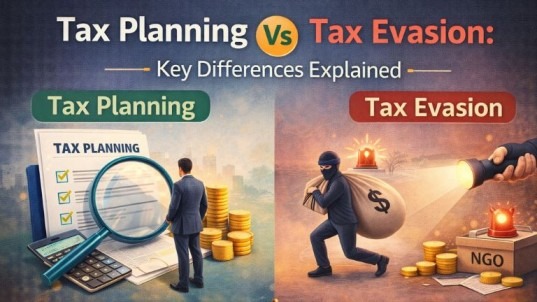
The government of India generates revenue mainly from taxes to support nation’s economic growth. The taxes collected from individuals and corporates are utilised towards initiatives such as infrastructure development, healthcare, education, etc. However, there are certain ways to limit or reduce the tax liabilities and often it creates misunderstanding between tax planning and tax evasion.
The tax environment of India is evolving, and it is vital for individuals and corporates to learn the key distinction between Tax planning Vs. Tax Evasion. The purpose of both activities is same, i.e., to reduce the tax liability but they differ in legality, intent, and consequences.
Understanding tax planning vs tax evasion is necessary not onlyindividuals and corporates but also for professionals actively working in the fields of finance, law, and corporate governance.
This blog explains the concept of Tax planning Vs. Tax Evasion on the grounds of legality, intent, and consequences, its key differences and cruciality of ethical and compliant tax strategies for sustainable financial management.
What is Tax Planning?
Tax Planning is the process of reducing the tax liability legally and ethically. Under this process, the financial matters of the assessee are arranged in such a way that the assessee can get the maximum benefits of exemptions, deductions, provisions, and other incentives given in the Income Tax Act.
The consultation of an expert tax professional is recommended to reduce the tax burden as it needs deep analysis of total income, expenses, savings, debts, investments and requires a smart investment strategy. General methods of tax planning include: –
- Tax-saving Fixed Deposits,
- Equity-Linked Savings Schemes (ELSS),
- Public Provident Funds (PPF),
- National Pension Schemes (NPS),
- Claiming deductions for insurance premiums under Section 80D and Section 80C. etc.
Tax Planning allows businesses to optimise legal incentives, deductions and depreciation through a structured financial system. Proper tax planning not only reduces the risks of tax authority disputes but also allows tax liabilities to be predictable and manageable.
Tax planning encourages the assessee to generate wealth for long term, invest smartly and help to prevent excess fines and legal prosecutions.
What is tax evasion?
Tax evasion is the criminal act of avoiding the tax liabilities through constructing false information and deconstructing the true facts. It is an illegal practice that involves dishonest methods such as underreporting income, inflating deductions and failing to file returns. Tax evasion involves the unlawful laying out of one’s financial affairs with the objective of minimizing taxes.
When financial arrangements are not in order and assessee purposefully engages in dishonest means to lower or cancel their tax liability, such assessee shall be held liable for criminal offence under the Income Tax Act, 1961. There are several illegal ways to avoid tax liability that are covered under tax evasion are: –
- Failure to declare all sources of income or under-reporting income on financial statements.
- Creating fake accounts, paperwork or invoices to deduct non-existent expenses or exemptions.
- Smuggling goods to avoid import fees and custom duties
- Avoiding taxes by depositing wealth in offshore accounts
- Submitting false information in tax return.
Tax evasion involves severe legal consequences such as heavy penalties, interest on unpaid taxes and sometimes assessee may face imprisonment as well. The Income tax Act, 1961 has strict provisions to detect and penalize such activities through audits, investigations, and data analysis.
Tax Planning vs Tax Evasion: Key differences
The government runs its operations significantly through the taxes collected from individuals and businesses and every taxpayer aims to reduce the tax liability and pay the minimum amount as taxes for the assessment year. Tax Planning vs Tax Evasion are two significant processes through which a taxpayer can significantly reduce their tax liability, but both the process varies based on the reasons, legality, ethical considerations, and consequences. Let’s dive deep to understand the critical line between smart tax strategy and illegal conduct.
| Aspect | Tax Planning | Tax Evasion |
| Definition | Tax planning is a process of reducing tax liability legally by using permissible methods within the framework of the law. | Tax evasion is the process of deliberately concealing income or misrepresenting facts to illegally reduce tax liability |
| Legality | Tax planning is legal and it is permitted and encouraged by government itself. | Tax evasion is illegal and a criminal offence under the Income Tax Act, 1961. |
| Nature | The nature of tax planning is transparent and the same is disclosed to tax authorities. | The nature of tax evasion is secretive, fraudulent, and deceitful. |
| Intent | Tax planning is done with an intent to minimise tax within the boundaries of the law. | Tax evasion is done with an intent to evade tax by violating the law. |
| Methods Used | Tax deductions, exemptions, rebates, allowances, HRA claims, 80C investments, etc. | Hiding income, inflating expenses, falsifying records, maintaining black money in offshore accounts. |
| Timing | Tax planning is done in advance with proactiveness, and it is planned before the tax event. | It is done after tax liability arises and it is reactive and concealing. |
| Disclosure | Tax planning involves full disclosure to tax authorities and there are no hidden transactions. | Tax evasion involves deliberate non-disclosure or misrepresentation of income/assets |
| Moral Standing | Considered ethical | Considered unethical |
| Penalty | There are no penalties or prosecution in case of tax planning. | There are heavy fines + imprisonment + interest & prosecution in case of tax evasion. |
| Tax Liability | Tax liability is reduced legitimately using provisions of the Income Tax Act in case of tax planning. | Tax liability is reduced unlawfully by suppressing actual liability in case of tax evasion. |
| Examples | Investing in PPF/ELSS (Sec 80C), claiming HRA, taking home loan deductions, setting up a tax-efficient business structure | Not filing returns, under-reporting income, fake invoices, offshore black money accounts |
| Approach | The approach is to work with the law | The approach is to work against the law |
| Effect on Economy | It encourages investment and savings and supports economic goals set by government | It drains public revenue and is harmful to national infrastructure and welfare |
| Expert Involved | Chartered Accountant, Tax Consultant, Financial Planner | Often no expert is there to advise for tax evasion or there is an unscrupulous advisor facilitating fraud |
Conclusion: Tax Planning vs Tax Evasion
It is very important for every taxpayer to understand and grasp the distinction between Tax Planning vs Tax Evasion. Every taxpayer has a legal right to organize his or her financial affairs to reduce tax payable, but it is a duty for the taxpayer to abide by the law, failing which it can cause legal consequences such as prosecution, imprisonment, and financial ruin. Therefore, it is always advisable for individuals and businesses to adopt legal tax planning strategies and abide by tax laws.
Frequently Asked Questions
Q-1: – Can tax planning ever accidentally cross into tax evasion?
A-1: – Yes, sometimes, tax planning can accidentally cross into tax evasion and taxpayer may face trouble. In such cases, expert advise is recommended and taxpayer shall make sure that there is no misrepresentation of facts and no misleading information is filed in the income tax return.
Q-2: – Can a business be prosecuted for tax evasion even if the owner claims ignorance?
A-2: – Ignorance is often an excuse of business owners but if the Income Tax Department finds certain misrepresentations and misleading information, ignorance is not admitted as an excuse for business owners. A business director, partner, or proprietor is expected to exercise due diligence over financial filings.
Q-3: – Does aggressive tax planning attract scrutiny even when it’s legal?
A-3: – Yes, aggressive tax planning may attract scrutiny even when it’s legal and the taxpayer can face with the right and proper documentation without any stress.
Q-4: – Does paying cash for large transactions count as tax evasion?
A-4:- Not necessarily but it raises red flags and if there are undisclosed transactions or transaction that violates the law, it may count as tax evasion.
Q-5: – Can donating to charity be used as tax planning?
A-5: – Donations to registered charitable organisations under Section 80G genuinely reduce your taxable income by 50% to 100% of the donated amount depending on the institution. This is legitimate tax planning with a dual benefit: social good and tax saving.
ALSO READ
Designated Partner vs Partner in LLP
LLP Annual Compliance Checklist-Forms
Companies Compliance Facilitation Scheme