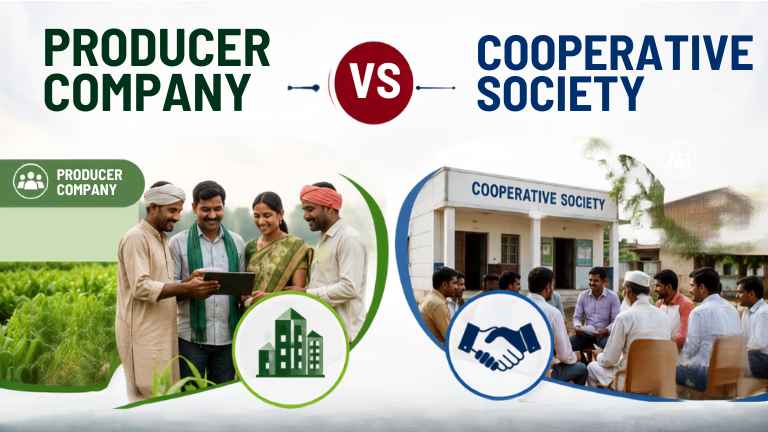
Irrespective of fact whether you are farmer collectives, Agri-entrepreneurs, and producer groups, choosing the right legal structure is essential to transform a group of small producers from struggling individuals into a thriving, market-competitive entity.
For this transformation, you would have two main options: Producer Company vs Cooperative Society. Both structures aim towards member empowerment through collective action but differs based on governance, scalability, regulation, and long-term potential.
This blog is not just theory. We will unpack the nuances drawing from real-world practice to make an informed decision between Producer Company vs Cooperative Society.
Let’s unpack it one by one.
Cooperative Societies: The Traditional Structure for Collective Action
To make an informed decision, knowing the exact description of Producer Company vs Cooperative Society is crucial.
Let’s look at the tradition structure of Cooperative Societies.
The Structure of Cooperative Societies is rooted in the principles of mutual help and democratic control and have been the backbone of India’s rural economy for over a century.
The traces of Cooperative Societies are from the Cooperative Societies Act, 1912 but most of the Cooperative Societies function under state-specific Cooperative Societies Acts or the Multi-State Cooperative Societies Act, 2002 having operations across multiple states.
Cooperative Societies are form of associations of people who collectively operate together for their economic, social, and cultural needs.
Cooperative Societies doesn’t require any capital investment and members collectively pool resources, share risks and benefit based on their patronage or participation.
Co-operative societies have a democratic principle of one member one vote that ensures fair decision making regardless of how much share capital someone holds.
Key Features of a Cooperative Society
- Anyone meeting the basic criteria can become a member. Its Open to individuals or other cooperatives.
- A Managing Committee look after governance issues and norms, and day-to-day operations are handled by secretary or manager.
- Profit distribution is based on contribution made called as patronage bonus instead of shareholding.
- Registrar of Cooperative Societies regulates the matters related to cooperative societies such as audits, approvals for major decisions and sometimes political influence.
Real World Example: AMUL started as a cooperative and scaled massively through federations. It is a legendary success story of co-operative society structure.
Producer Companies: The Modern Hybrid Solution
Choosing between Producer Company vs Cooperative Society requires the knowledge of modern structure of producer company.
Let’s look at the Modern Hybrid Solution which is producer company.
The Structure of Producer Companies is a modern solution that address the shortcomings of traditional cooperatives.
This structure was recommended by the Y.K. Alagh Committee to blend democratic principle of one person one vote with the efficiency, professionalism and flexibility of corporate structures.
Further, the structure of producer company was introduced in Companies (Amendment) Act, 2002 and is now sacred part of Companies Act, 2013.
A producer company is a company specifically curated for primary producers like farmers, artisans, dairy owners, etc. Small Self-help groups may also incorporate a producer company to carry out activities related to production, harvesting, procurement, grading, pooling, handling, marketing, or export of primary produce.
Key Features of Producer Company
- Membership is restricted to the primary producers or producer institutions. Incorporation of Producer company requires minimum of 10 individuals or 2 producer institutions.
- Board of Directors look after governance issues and norms where appointment of a CEO is mandatory. There is also a provision to co-opt professionals or experts.
- The key feature of producer company structure is limited liability of members up to their share of contribution.
- Profit distribution is allowed as dividends on shares and members are also rewarded based on patronage or participation.
- Registrar of Companies governs the matters related to Producer company that enables seamless operations across states without multiple registrations.
Producer Company vs Cooperative Society: Head-to-Head Comparison
| Aspect | Cooperative Society | Producer Company |
| Governing Law and Registration | Co-operative Societies are governed by respective State Cooperative Acts or Multi-State Cooperative Societies Act, 2002 in case of presence across states. | Producer Companies are governed by the Companies Act, 2013 irrespective of location of registered office |
| Government Control | The Government interference is comparatively higher. | The Structure of producer company provides for greater autonomy with minimal day-to-day government interference where standard corporate compliance needs to be followed. |
| Management and Professionalism | Cooperative Societies relies on elected members and it’s possible to find gaps in expertise and professional management. | The Structure of producer company mandates appointment of CEO and there is also provision to co-opt professionals or experts. |
| Area and Scalability | The operations of Cooperative Societies are often state bound. | Producer Companies can operate nationwide easily. |
| Capital Raising | The Capital of Cooperative Societies depend on member contributions and government schemes | Producer Companies have multiple options to raise capital. It can issues shares, attracts investments, forms JVs and can accesses equity markets as well. |
| Voting and Control | It works on democratic principle of One member one vote | Usually, producer companies also work on democratic principle of one member one vote but with an option of share linkages in Articles of Association. |
| Shares and Exit | Exit options are limited for members of cooperative society. | Shares are transferable within members and accordingly it comes with feature of better liquidity of investment made. |
| Taxation and Compliance | There are certain exemptions for cooperative societies, but it varies from state to state. | Taxation and compliance is aligned for producer companies with some producer incentives but it has to follow standardized MCA/ROC filings. |
Advantages and Potential Drawbacks: Producer Company vs Cooperative Society
| Category | Cooperative Society | Producer Company |
| Key Advantages | Easier & cheaper formation; Strong community focus & social impact; Established government support ecosystem; Tax benefits on patronage distributions; Ideal for small/localized groups | Professional management for efficiency & innovation; Superior access to finance, markets & technology; High flexibility to scale & diversify (processing, exports, branding);Minimal government interference; hybrid model balancing ownership with corporate tools |
| Main Drawbacks | Bureaucracy; Limited growth capital; Risk of political capture; challenges in professionalizing operations; Inefficiency at scale | Higher compliance costs & complexity; Requires more initial capital & legal expertise; Less suitable for purely welfare-oriented or very small informal groups; Minimum membership & documentation can deter beginners |
Producer Company vs Cooperative Society: Which One Should You Choose?
You should always look at your long-term goals if you must choose between the two structures: Producer Company vs Cooperative Society.
In essence, your vision matters.
If your goal is to incorporate an organisation that is localized and social welfare focused where you want to opt for state level schemes heavily; lean toward a Cooperative Society.
On the other hand, if you wan to scale your business, create value for customers, manage organisation professionally and reach throughout the nation a Producer Company is often superior.
Still confused, consult our expert team to know which structure suits your business profile.
Conclusion: Producer Company vs Cooperative Society
There is no universal fact that can establish the better option between Producer Company vs Cooperative Society.
As it is already described earlier, it totally depends on your long-term goals and vision towards your business.
In a rapidly modernizing India, where small producers face climate risks, market volatility, and supply chain demands, the flexibility of Producer Companies offers a compelling edge.
Yet cooperatives retain immense value for grassroots empowerment and have a proven track record.
If you’re ready to move forward with either structure, prioritize member consensus, transparent governance, and professional handholding. The goal remains the same: stronger livelihoods for producers.
If you have any questions about registering a Producer Company or converting your cooperative? Feel free to reach out and take that first step towards a better business operations and great profits.
Frequently Asked Questions: Producer Company vs Cooperative Society
Q1: Which is better for small local groups between Producer Company vs Cooperative Society?
A1: Cooperative Society, due to simpler formation and lower initial costs.
Q2: Can a Producer Company operate across India?
A2: Yes, under single central registration, unlike most state-bound cooperatives.
Q3: Is professional management mandatory in Producer Companies?
A3: Yes, a CEO must be appointed, unlike in cooperatives.
Q4: Which structure offers better access to capital?
A4: Producer Company, through shares, investments, and joint ventures.
Q5: Can a cooperative convert to a Producer Company?
A5: Yes, with member approval and regulatory clearances.
ALSO READ
FCRA Bill 2026 Explained: What Every NGO Needs to Know
LLP Form 8 Due Date, Penalty and Filing Process
A Compete Guide of LLP Form 3 Filing
Step-By-Step Process of Producer Company Registration
Dematerialization of Shares for Non-small Private Companies
Post Incorporation Compliances of a Private Limited Company