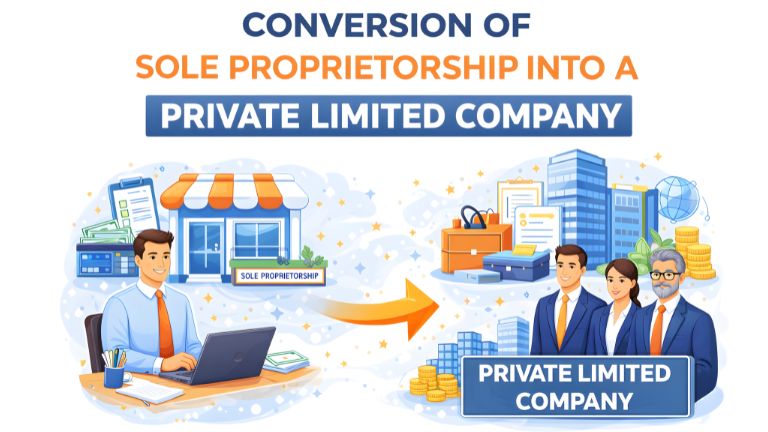
Convert Sole Proprietorship into a Private Limited company is a wise move by business owners who aspire to expand their operations, curtail their personal risk, as well as increase their business credibility. The sole proprietorship business structure lacks legal identity and liability of sole proprietor is also unlimited. When the founder or entrepreneur wishes for convert Proprietorship to a Pvt Ltd company, a new private limited company is incorporated to and after incorporation, the company takeover the sole proprietor business.
Upon business expansion, convert Proprietorship into a Private Limited provides numerous benefits, like limited liability, perpetual succession, and long-term credibility and opportunities to raise funds in the long run.
This blog will guide you on the meaning, eligibility criteria, legal formalities, documents needed, tax implications, GST transfer, MOA & AOA provisions, advantages, timelines, and FAQs in regard to convert Sole Proprietorship into a Private Limited company.
What is Convert Proprietorship into Private Limited Company?
The conversion of sole proprietorship business into private limited company is a process where a newly incorporated private limited company takes over the running sole proprietorship business in relation to all aspects, such as assets, liabilities, agreements, employees, and so forth.
All of these aspects are executed by a “Business Takeover Agreement.”
Eligibility Criteria for Convert Proprietorship into Private Limited Company
The following criteria shall be fulfilled for Conversion of Sole Proprietorship into Private Limited Company in India.
- Minimum Two Directors and Shareholders (can be same)
- At least One Resident Director in India
- PAN, Aadhaar, and Address Proof of the promoters/directors
- Permissible Business Activity under the Companies Act, 2013
These criteria for eligibility are integral part to the smooth Convert Proprietorship into Private Limited Company in India.
Legal Procedure for Convert of Sole Proprietorship into Private Limited Company in India.
The conversion procedure is composed of the following:
Step 1- Acquire Digital Signature Certificates (DSC)
The proposed directors and subscribers are required to have DSCs for filing form online on MCA portal.
Step 2- Name Approval from MCA
Submit an application for the approval of the company name via the MCA portal. The name should preferably be the same as, or similar to, the existing name of the proprietorship. Make sure the name does not resemble to any existing company and the desired name is available for trademark as well.
Consult us today to get a full guide on conversion of your Sole Proprietorship into Private Limited Company where we help you and guide you throughout the conversion process.
Step 3- Drafting the MOA and AOA
Draft Memorandum and Articles of Association incorporating takeover and conversion provisions.
Step 4- Filing of Incorporation Documents with ROC
Submit file SPICe+ forms, as well as supporting documentation for incorporation.
Step 5- Certificate of Incorporation (COI)
After approval, the Certificate of Incorporation is issued by the Registrar of Companies.
Documents Required for Convert of Sole Proprietorship into Private Limited Company
- PAN & Aadhar Card of Directors: The identity proof of all proposed directors is required.
- Address Proof of Registered Office: Utility bill/rent/ownership documents for the office.
- Latest Utility Bill: For the purpose of validating the registered office address.
- Proprietorship Business Proof: Copy of existing business registration or GST certification/trading license.
- No Objection Certificate from Proprietor: This will authorize the transfer of the sole proprietary business to the company.
- Draft Memorandum and Articles of Association: Including conversion-specific provisions and provisions for takeovers.
Business Transfer in Course of Conversion of Sole Proprietorship into Private Limited Company
The transfer of the business is effected by way of a Business Takeover Agreement that provides for the following:
- Transfer of assets and liabilities
- Assignment of Licenses and Registration
- Transfer of employees and contracts
- Transfer of goodwill
Business Takeover Agreement maintains the continuity of your business in a legal way.
GST Transfer on Conversion of Sole Proprietorship into Private Limited Company
The GST registration can be transferred to this private limited company through the GST website through Form ITC-02. This enables hassle-free transfer of the Input Tax Credit.
Tax Aspects of Conversion of Sole Proprietorship into Private Limited Company
Conversion may trigger tax on gains, depending upon:
- Mode of consideration (shares or cash)
- Valuation of assets & liabilities
Appropriate tax planning can further assist in reducing taxes. Consult us today to plan your tax efficiently that let you move to a better business structure with minimum tax liability.
Benefits of Convert of Sole Proprietorship into Private Limited Company
Convert Sole Proprietorship into Private Limited Company has several benefits for the entrepreneur in India, which include the following:
- Limited Liability: The personal property of the stockholders is secured, as the liability of the stockholders is limited to the share capital of the company.
- Increased Business Credibility: A private company gains credibility and authenticity in the opinions of banks, investors, and customers.
- Ease of Funding and Investments: Raising finances by equity investment, venture capital, and borrowing will become easy.
- Perpetual Succession: The existence of the business will continue regardless of changes in ownership and management.
Time Required for Conversion of Sole Proprietorship into Pvt limited company
The time required for the entire process for the convert sole proprietorship into pvt limited company will take around 10 to 15 working days, depending on the availability of documents and the time taken by the Registrar of Companies (ROC) and the government.
Proper documentation and professional processing would ensure that this procedure runs smoothly and on time.
Clauses within MOA for Conversion of Sole Proprietorship into Pvt ltd Company
Object Clause
“To carry on the business of ________ as was previously carried on by the Sole Proprietorship concern in the name of ________.”
“Takeover / Conversion Clause”
“To take over as a going concern the business of the Sole Proprietorship carried on by Mr./Ms. ________.
Consideration Clause
“The consideration may be discharged by issue of equity shares, cash, or both.”
Ancillary Objects Clause
“To enter into agreements necessary for conversion of the proprietorship into a company.”
Clauses within AOA for Convert of Sole Proprietorship into Private Limited Company
1.Business Transfer Authorization Clause
Authority of Board of Approval of Takeover
“The powers to approve and execute agreements for taking over or acquisition of the sole proprietorship business and to accept the transfer of assets and liabilities shall vest in your Board of Directors.”
2.Issue of Shares to Proprietor
When consideration is shares of stock:
“The Board may issue equity shares to the proprietor of the formerly sole proprietorship business as a consideration for the transfer of the business to the Company.”
3.Value of Loss
For fair value determination
“The valuation of assets and liabilities of the sole proprietorship business will be done by a Chartered Accountant or by such professional, as may be appointed by the Board.”
4.Contracts Clause
Continuity of existing contracts
“All contracts, arrangements, and engagements entered into prior to conversion by the sole proprietorship shall be deemed to be contracts of the Company upon takeover.”
5.Employee Continuity Clause
Employees protection
“All employees engaged in the sole proprietorship business are required to continue their service with the Company without break/interruption on the same terms and conditions.”
Conclusion
Conversion of sole proprietorship into private limited company is both growth-oriented and legally sound. Seamless continuity and scalability of long-term business can be ensured with correct documentation, proper tax planning, and regulatory compliance.
Still have any doubt in the process of Conversion of sole proprietorship into a private limited company?
Consult My Legal Business LLP today for the smooth conversion of Sole Proprietorship into Private Limited Company for end-to-end legal and compliance support and professionally drafted MOA, AOA & business takeover agreement.
FAQs on Conversion of Sole Proprietorship into a Private Limited Company
1. What does conversion of sole proprietorship into private limited company mean?
The conversion of sole proprietorship into pvt limited company is a process of incorporating a new company and transferring the already existing business of the sole proprietorship into the newly formed company through a legal takeover.
2. Is conversion of sole proprietorship into a private limited company legal?
Yes, the conversion of sole proprietorship into a private limited company is legal. However, there being no separate legal entity in case of a sole proprietorship, the process of changeover would involve forming a private limited company and sale of business.
3. Which laws regulate the conversion of sole proprietorship into private limited company?
There is no direct automatic conversion provision under the Companies Act, 2013. The same is based on incorporation provisions and business transfer contracts.
4. Is the conversion of sole proprietorship into a private limited company subject to ROC approval?
Yes, the incorporation of the private limited company needs ROC approval, but the business transfer takes place in the context of a private agreement.
5. Is the same business name allowed after conversion?
A similar name can also be used provided it is available and is subject to approval of the Registrar of Companies.
6. What documents are required for conversion of sole proprietorship into pvt limited company?
Crucial documents include director’s Identity Proof, Proof of Registered Office, Proof of Proprietorship Business, NOC from Proprietor, and Draft MOA & AOA documents.
7. Is a business transfer agreement required for conversion?
Of course, it is necessary for a business takeover or transfer agreement since it is what will ensure the transfer of assets, liabilities, as well as business operations into the company.
8. How are assets and liabilities treated during the conversion process?
The assets and liabilities will be transferred according to the agreement stipulated in the business transfer agreement between the proprietor and the company.
9. Can GST registration be transferred post-conversion?
Yes, the GST registration can also be transferred to the private limited company by submitting the form ITC-02 on the website of the GST.
10. Will capital gains tax apply to the conversion of a sole proprietorship into a private limited company?
In respect of capital gains tax: Tax liability is possible in relation to capital gains tax, dependant upon the structure of consideration. Tax planning is advisable in order to avoid the incidence of the tax.
11. Can the proprietor become a director and shareholder after conversion?
Yes, the proprietor typically becomes a director/shareholder in the newly formed private limited company after incorporation.
12. What happens to existing contracts after conversion?
The existing contracts can also be adopted by the company if the adoption is possible in the takeover agreement and the parties are notified accordingly.
13. How long does it take to convert a sole proprietorship into a private limited company?
The process usually takes 10 to 15 working days, subject to ROC approval timings.
14.Does it necessarily imply that the proprietorship has to be closed down upon conversion?
Yes, upon transfer of business, the proprietorship should be closed and thereby related registrations surrendered or updated.
15. State the advantages of converting sole proprietorship into a private limited company.
The main advantages are limited liability, improved integrity, ease of funding, perpetual succession, and strict compliance.
ALSO READ
Difference Between One Person Company and Sole Proprietorship
Trademark Registration for Sole Proprietorship
Step-By-Step Process of NSIC Registration: 2026 Edition
How to Register Copyright in India: Step-by-Step Guide