A Section 8 Company is formed for charitable and non-profit objectives such as promoting education, research, social welfare, art, environment, and similar causes. These companies enjoy certain benefits under the Companies Act, 2013, but they are also subject to stricter regulatory control.
One common question asked by founders and professionals is whether a Section 8 Company can be struck off from the Register of Companies.
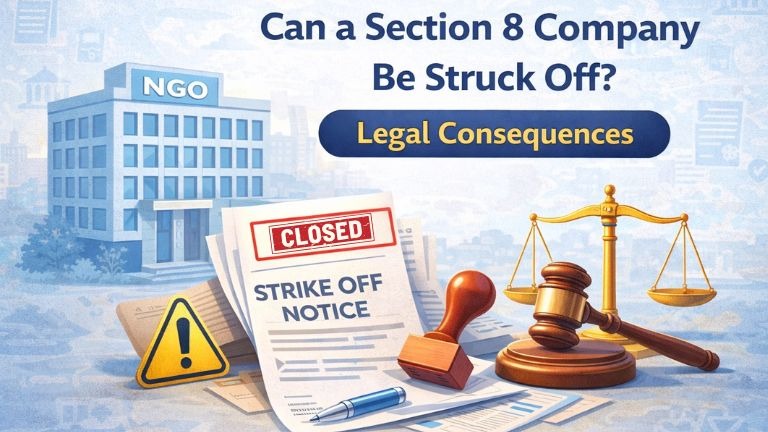
The legal position is that a Section 8 Company cannot normally be struck off directly by the ROC under Section 248, because it operates under a special license granted by the Central Government.
Before closure, the licence must be cancelled and the company may need to convert into a normal company.
This article explains the correct legal process, provisions, and forms involved.
What is a Section 8 Company?
A Section 8 Company is a non-profit company registered under Section 8 of the Companies Act, 2013.
It is established for purposes such as:
- Education and research
- Social welfare and charity
- Promotion of art, culture and sports
- Environmental protection
- Religious or charitable activities
Unlike other companies, profits cannot be distributed to members. All income must be used only for to promote the company’s objectives.
Can a Section 8 Company Be Struck Off Directly?
In general, a Section 8 Company cannot be directly struck off by the ROC under Section 248.
This is because:
- A Section 8 Company operates under a license issued by the Central Government.
- As long as the license exists, the company must continue to comply with the conditions of Section 8.
- Therefore, the license must first be revoked or the company must convert into another type of company.
Only after the license is cancelled or the company is converted into a normal company can strike off under Section 248 be applied.
Legal Provisions Governing Closure of a Section 8 Company
The closure or removal of a Section 8 Company is governed by the following provisions of the Companies Act, 2013:
Section 8(6)
Provides that the Central Government may revoke the license of a Section 8 Company if it:
- Violates license conditions
- Acts fraudulently
- Operates against its stated objectives
Section 8(7)
After revocation of license, the government may direct the company to:
- Convert into another type of company, or
- Wind up the company.
Section 248
Provides the procedure for removal of name of a company from the register (strike off).
This normally applies after conversion or when the company is no longer operating as a Section 8 entity.
Section 455
Provides for dormant company status if the company wants to remain inactive but not close.
Companies (Incorporation) Rules, 2014
These rules prescribe the forms and procedure relating to Section 8 companies.
Reasons for Closure of a Section 8 Company
A Section 8 Company may need to be closed due to:
1. Inactive operations
The company is not carrying out charitable activities.
2. Financial difficulties
Lack of funding or resources to continue operations.
3. Completion of objective
The purpose for which the company was formed has already been achieved.
4. Compliance burden
Continuous compliance requirements make continuation difficult.
5. Violation of license conditions
Misuse of funds or activities outside charitable objectives.
Correct Legal Process for Closing a Section 8 Company
The closure generally involves two stages.
Step 1: Board Resolution
The Board of Directors approves the proposal to close the company or convert it.
Step 2: Member Approval
A special resolution is passed in a general meeting approving:
- surrender of license or conversion.
- Filling of form MGT-14.
Step 3: Application for Revocation of Licence
Application is made to the Central Government (through ROC) for revocation of the Section 8 licence.
Relevant forms may include:
- Form GNL-2 – Application to Regional Director for revocation of license.
- Form INC-18 – Application to Regional Director for conversion from section 8 to normal company.
Step 4: Government Review
The Regional Director examines whether:
- liabilities are cleared
- assets are transferred to another charitable organisation
Step 5: Conversion into Normal Company
If approved, the company may convert into:
- Private Limited Company, or
- Public Limited Company.
6. Strike Off After Conversion
Once the company becomes a normal company, it may apply for strike off.
Procedure
- Board Resolution approving strike off
- Special Resolution of Members
- Settlement of all liabilities
- Closure of bank accounts
- Filing application in Form STK-2
Forms used:
- STK-2 – Application for strike off
- STK-3 – Indemnity bond
- STK-4 – Affidavit
- STK-6 – Notice by ROC
After verification, the ROC publishes notice in the Official Gazette and removes the company’s name.
Consequences of Closure
When the company is finally struck off:
- The company ceases to exist legally
- Bank accounts cannot be operated
- Directors remain liable for past liabilities
- Any remaining assets must be transferred according to legal provisions
- The Section 8 licence stands cancelled
Importantly, assets of a Section 8 Company Registration cannot be distributed to members.
Revival of a Struck Off Company
A company that has been struck off may apply for restoration before the National Company Law Tribunal.
Application must generally be filed within three years under Section 252 of the Companies Act, 2013.
If the Tribunal finds that the company was active or the strike off was improper, it may order restoration.
Conclusion
A Section 8 Company is a kind of company that cannot be closed down easily. This is because it works under a special license given by the Central Government.
Before closure, the license must be revoked or the company must convert into a normal company. After the Section 8 Company becomes a company it can be closed down by following the usual steps, under Section 248. To do this the company has to fill out a form called Form STK-2.
So people who run Section 8 Companies should make sure they follow all the rules and get all the approvals before they try to close the Section 8 Company.
FAQs
1. Can ROC directly strike off a Section 8 Company?
No. Since the company operates under a Central Government license, the license must first be revoked or the company must be converted.
2. Which authority can revoke the Section 8 license?
The Central Government through the Regional Director can revoke the license under Section 8(6).
3. Which form is used for strike off after conversion?
After conversion into a normal company, Form STK-2 is used to apply for strike off.
4. Can members receive assets of a Section 8 Company?
No. Assets must be transferred to another similar charitable organisation.
5. Can a struck off company be revived?
Yes. An application can be made to the National Company Law Tribunal (NCLT) under Section 252.
ALSO READ
LLP Annual Compliance Checklist
Is MOA More Important Than AOA