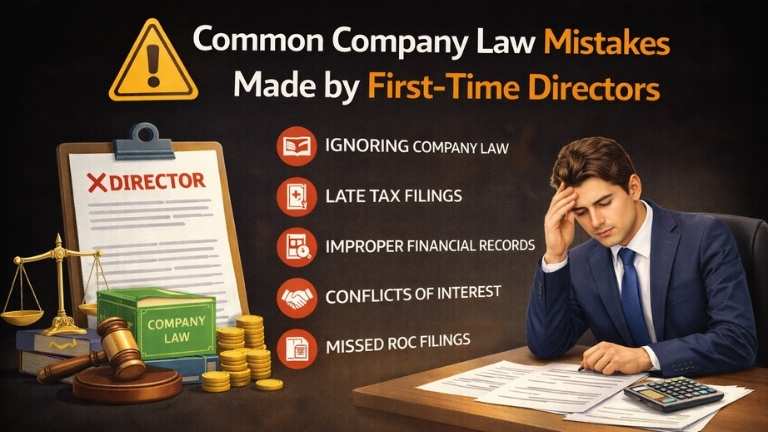
Having the title of company director is something to be proud of and it represents a leadership role within a company and working as an entrepreneur. Despite this, the legal nature of the role is hugely underestimated by many first-time directors. You are required to make proper decisions. Even an inadvertent breach can lead to fines, disqualification, criminal proceedings, and personal liability. This article will outline the most common company law errors made by new directors, the consequences, and a few key tips on how to continue to keep out of trouble, particularly in the context of start-ups, private limited companies and MSMEs
Who Is a Director Under Company Law?
According to Section 2(34) of the Companies Act, 2013, a director is defined as “a person appointed to the Board of a company.”
The duties of a director are:
- Compliance with the law
- Acting in good faith
- Looking after the interests of stakeholders
- Avoiding conflict of interest
- Exercising due care and diligence
Ignorance of the law is no defence for directors, including non-executive and nominee directors in most instances.
Common Company Law Errors Made by First-Time Directors
Assuming Directors Are Not Personally Liable
The mistake
First-time directors often assume that because a company is a separate legal entity, its directors cannot be held personally liable.
Legal reality
Although a company is a separate legal entity, directors of company can be held personally liable for:
- Fraud (Section 447)
- Misrepresentation in prospectus
- Failure to file statutory returns
- Dishonour of cheques
- Tax and GST defaults (in certain circumstances)
Legal Consequences
- Fines
- Criminal charges
- Disqualification of directors
- Seizure of personal property
Non-Filing or Delayed Filing of ROC Forms
The Mistake
Overlooking or postponing the compulsory filing of ROC forms, including:
- AOC-4 (financial statements)
- MGT-7 / MGT-7A (annual return)
- DIR-12 (director changes)
- ADT-1 (auditor appointment)
Legal Consequence
As per Sections 92, 137, and 403, the following penalties are imposed for late filings
- High additional fees (₹100 per day, with no maximum in most instances)
- Director disqualification under Section 164(2)
Reality Check
Every year, thousands of directors are disqualified because of mere non-filing defaults.
Ignoring Director Disqualification Provisions
The Mistake
Don’t know about the eligibility criteria under Section 164.
Reasons for Disqualification:
- Non-filing of financial statements for consecutively 3 financial years
- Failure to refund deposits or debentures
- Conviction for moral turpitude
- Being a director in a struck-off company
Consequences
- DIN will be deactivated
- Cannot be a director in any company
- Debarred from incorporating a new company
Failure to Hold Proper Board Meetings in company
The Mistake
Skip board meetings and meet only once in a year at annual general meeting’
Legal Requirement (Section 173)
- A minimum of 4 board meetings required to be held in a year
- A maximum gap of 120 days between two board meetings
- Appropriate notice, agenda, and minutes are mandatory for every board meetings
Consequences
- Fine on the company and its directors
- Unenforceable board resolutions
- Breakdown in governance
Not Maintaining Statutory Registers & Records
The Mistake
Not maintaining:
- Register of members
- Register of directors & KMP
- Register of charges
- Minutes books
Consequences
Under Sections 88, 118, 170, non-maintenance of register, records attract penalties.
Signing Documents Without Understanding Legal Implications
The Mistake
Signing financials, guarantees, bank documents, or compliance certificates blindly.
Why This Is Dangerous
A director’s signature:
- Confirms correctness of information
- Attracts personal responsibility
- Can be used as evidence in prosecution
“I trusted my CA or accountant” is not a valid legal defence.
Conflict of Interest & Non-Disclosure of interest
The Mistake
Failure to disclose interest in:
- Related party transactions
- Contracts or arrangements
- Shareholding in group entities
Legal Requirement
Section 184 & 188 require:
- Disclosure of interest
- Board approval
- Shareholder approval in some cases
Penalty
- The transaction is voidable
- Fine and imprisonment
- Loss of directorship
Non-Appointment of Auditor on Time
The Mistake
Believing that the appointment of the auditor can be done at a later date.
The Legal Rule
- Appointment of the auditor must be done within 30 days of incorporation
- Filing of ADT-1 is mandatory
The Impact
- Company will be considered as non-compliant from Day 1
- Penalties on the directors
Incorrect Resignation of Director
The mistake
Resignation of a director is considered complete by merely sending an email or a letter.
The Legal Requirement
- DIR-12 to be submitted by the company
- DIR-11 (optional but recommended) to be submitted by the director
- Correct board meeting noting to be done
The Risk
- Continued liability despite exit
- Notices from ROC received years later
Blending Personal and Business Funds
The Mistake
Personal use of the company account as an individual wallet.
Legal Implication
- Breach of fiduciary duty (Section 166)
- May also constitute fraud or misfeasance
- Issues during audit and tax examination
Overlooking Compliance Despite Company Inactivity
The Mistake
Ceasing business operations without closing the company formally.
Reality
Until the company is struck off or wound up:
- Annual returns are still pending
- Fines continue to accrue
- Directors are still personally liable
Not Seeking Legal Advice at the Right Time
The Mistake
Seeking professionals after receiving notices.
Result
- Limited remedial measures
- Harsher penalties
- Cost of litigation
How First-Time Directors Can Stay Compliant?
- Familiarize themselves with director responsibilities under Section 166
- Use compliance calendar
- Personally review filings
- Hold regular board meetings
- Seek professional legal advice
- Respond proactively, not reactively
Why Choose My Legal Business LLP for Director Compliance & Corporate Governance?
At My Legal Business LLP, we are director-focused compliance and governance experts, particularly in:
- First-time directors
- Startup founders
- Private limited companies
- MSMEs & family businesses
What Makes Us Unique?
- Director-Focused Advisory – We break down the law in simple, non-technical terms
- End-to-End ROC Compliance – From incorporation to winding up
- Disqualification & Revival Specialists
- Customized Compliance Calendar
- Risk Identification
- Clear Pricing & Unwavering Support
We do not merely submit documents; we shield directors from potential future liability.
Conclusion
A director holds not only power but also a statutory obligation under the Companies Act, 2013, particularly in relation to the company’s secretarial compliance. Most new directors do not fail due to negligence; rather, they fail because they are unaware of what they do not know, delay compliance, or rely too heavily on professional advice instead of exercising independent judgment. By understanding common legal pitfalls, staying current with compliance requirements, and seeking proactive legal guidance, directors can safeguard themselves against fines, disqualification, and litigation. With the right team in place, serving as a director remains a position of advantage rather than risk.
Frequently Asked Questions (FAQs)
Are first time directors personally liable for defaults in companies?
Yes, directors could be held personally liable for non-compliance of the statues, fraud and negligence as per the provisions of the Companies Act, 2013 even in cases of unintentional or inadvertent default.
Can a director be disqualified without notice?
Yes, under Section 164(2) on account of default in filing annual returns/financial statements for three years continuously by a company.
Is ignorance of company law a valid defence for directors?
No, they are supposed to take reasonable care and diligence.
What are the liabilities and responsibilities of non-executive or nominee directors?
Yes, their capacity is limited, but they are still culpable in cases of compliance defaults if they know about it, are liable for it or act with indifference about it.
Which compliance mistake is most common among Company Directors?
The most common mistake is the late/non-submission of ROC forms AOC-4 and MGT-7.
Is it possible to hold directors accountable for the actions of accountants/CAs that result in losses?
Yes, there are personal liability of the directors for the errors made by the accountants or CAs.
Do board meetings need to be held on a regular basis.
Yes, A notice to attend, the agenda and the minutes a company must have a certain minimum meeting of the board in a year under section 173.
Is there a liability associated with signing financial statements?
Yes, that is true. While the director’s signature on the financial statement is a representation that it is true and correct, if the statement is untrue or misleading and the director is held liable in any manner at a later time, we know that he will not be so kind as to say that he did not know what he was signing.
Is it possible to seize the personal assets of the directors?
Yes, in instances of fraud or misfeasance, or for recovery of statutory dues, the personal assets of the director can be attached by the authorities.
Is the appointment of auditor’s compulsory for all companies?
Yes, the appointment of an auditor is compulsory for all companies, regardless of size, turnover or whether they are active.”
ALSO READ
Can a Private Limited Company Operate Without a Company Secretary
Can One Person Be Director in Multiple Companies
How to Close a Company Legally in India
Registration of Startup under DPIIT
Conversion of Sole Proprietorship into a Private Limited company
Step-by-step Process of GST Registration
How to remove Director disqualification