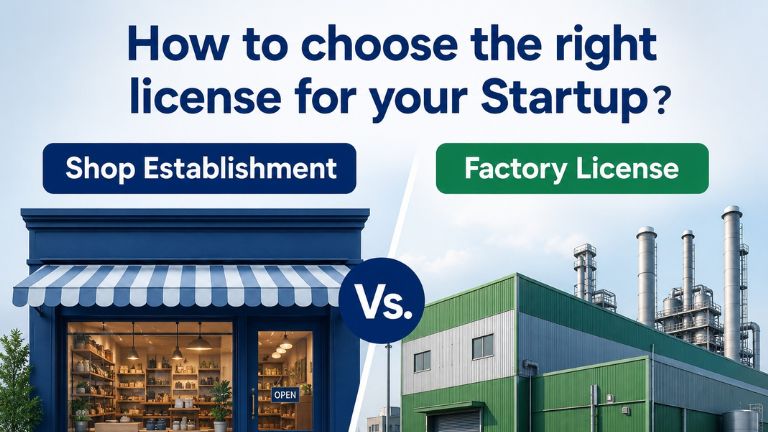
One of the first big decisions every new founder face is to choose between a Shop Establishment License and a Factory License. If you get it right, your startup runs smoothly with less paperwork and lower costs.
A Shop Establishment License works well for most retail, trading, service, and small office-based startups. On the other hand, a Factory License becomes necessary once you start manufacturing activities, use heavy machinery, or employ a larger number of workers in a dedicated production unit.
The difference between Shop Establishment Vs. Factory License affects your compliance with labour laws, safety requirements, and renewal timelines. Many founders later regret picking the cheaper or easier option without understanding their actual business operations.
At initial stage, you should invest time to understand which license truly fits your startup. It will save your money; let you avoids penalties to focus more on growing your business instead of fighting legal issues.
In this blog, we shall deep dive into key differences between Shop Establishment Vs. Factory License, cost involved, renewal process, risk and penalties if you pick the Wrong License.
What Is a Shop and Establishment License and Who Needs it?
A Shop and Establishment License is a basic registration that most small and medium business enterprises in India must get from the state government. It is also commonly called Shop Act License or Shop License. This license tells the government that your business exists and follows basic labour and workplace rules.
You need a Shop and Establishment License if you run any of these:
- A retail shop or showroom
- An office for services like consulting, IT, marketing or legal work
- A trading business
- A restaurant, cafe, salon, gym or clinic
- An online business that has a physical office or godown
This license is compulsory in most of the states even if you have a small startup with just a few employees. It covers rules about working hours, holidays, wages and employee welfare.
Getting this license is quite simple and inexpensive compared to other approvals. It helps you stay on the right side of the law and avoid unnecessary fines or notices. If you are starting a new venture, it should be one of your first steps to check whether you need a Shop and Establishment License.
What Is a Factory License and When Does Your Business Require One?
When your company begins to engage in larger-scale production, you will require an official approval known as a factory license. It is far more stringent than a standard Shop Establishment License and falls under the Factories Act. It is issued by the government to guarantee worker safety, appropriate working conditions, and adherence to labour regulations.
When your startup surpasses specific thresholds, you need a Factory License. This typically occurs when you have 10 or more employees and utilize electricity for production, or when you have 20 or more employees without electricity. It also holds true if your production facility operates large gear or deals with dangerous products.
The factory license is only required for actual manufacturing installations when comparing shop establishment and factory licenses.
A Shop Establishment License is sufficient for most of the small office, retail, trading, and service enterprises. Making a poor decision can result in severe fines and legal issues.
Check the number of employees and power consumption as soon as possible if your company engages in production. Time, money, and future hassles can be avoided by obtaining the appropriate license at the early stage of business.
How Your Business Activity and Worker Count Decide the Right License?
Picking the correct license depends mainly on what your startup does and how many people you employ. Here is a simple breakdown:
- If your business is about trading, retail, services, consulting, IT, marketing, or running an office, you usually need only a Shop Establishment License.
- If your startup involves manufacturing, processing, assembling goods, or using heavy machines, you may have to get a Factory License instead.
- Worker count plays a big role in Shop Establishment Vs. Factory License decision. If the employee count is less than 10 using power or under 20 without power, most businesses can operate with a Shop Establishment License.
- Once you cross 10 workers with power or 20 workers without power in a manufacturing setup, the law requires a Factory License.
- Always check your daily operations first. Many founders start with a Shop Establishment License and later switch when production grows.
Shop Establishment Vs. Factory License: Key Differences
Shop Establishment License and Factory License are different licenses and it’s vital to know the key difference between both. The key differences are stated below explaining Shop Establishment Vs. Factory License.
| Basis of Difference | Shop Establishment License | Factory License |
| Meaning | Registration for shops, offices, commercial establishments, restaurants, service centres, and trading businesses. | License required for manufacturing units where goods are produced using workers and machinery. |
| Governing Law | State Shops and Establishments Act of the concerned state. | Factories Act, 1948 and relevant State Factory Rules. |
| Applicable To | Retail shops, offices, salons, hotels, consultancy firms, warehouses, IT offices, etc. | Industries engaged in manufacturing, processing, assembling, packing, or production activities. |
| Main Purpose | It regulates working hours, leave, holidays, wages, and employee conditions in commercial establishments. | It ensures worker safety, health, welfare, and proper working conditions in factories. |
| Issuing Authority | Local Municipal Authority, Labour Department, or State Department. | Chief Inspector of Factories / State Labour Department. |
| Worker Requirement | Usually, applicable even with a small number of employees depending on state rules. | It applies when manufacturing is carried out with minimum number of workers as prescribed by law. |
| Machinery Use | Not necessary. | It is usually required where power and machinery are used in manufacturing. |
| Safety Compliance | Basic workplace standards. | Strict rules regarding fire safety, ventilation, machinery safety, hazardous process control, etc. |
| Inspection | Limited inspections depending on local rules. | Regular inspections by factory inspectors. |
| Documents Required | ID proof, address proof, rent agreement, PAN, business proof, employee details. | Building plan approval, machinery details, NOC, safety plan, ownership proof, worker details, pollution approvals. |
| Validity | It varies from state to state. May require renewal in some states. | Usually renewable periodically as per state laws. |
| Penalty for non-compliance | Fine and possible closure notice. | Heavy penalties, prosecution, and closure risk. |
| Best For | Shops, offices, commercial businesses, service providers. | Manufacturing plants, production units, industrial premises. |
Quick Checklist to Decide Between Shop Establishment Vs. Factory License
If you are a new business founder, you can use his simple checklist to understand whether your business needs a Shop Establishment License or a Factory License.
| Question | If Yes | Likely License Needed |
| Do you run a shop, office, showroom, salon, restaurant, or service business? | Commercial activity | Shop Establishment License |
| Do you buy and sell goods without manufacturing them? | Trading business | Shop Establishment License |
| Do you employ staff for office, sales, billing, or customer service work? | Commercial establishment | Shop Establishment License |
| Do you manufacture, assemble, process, pack, or produce goods? | Industrial activity | Factory License |
| Do you use machines, tools, or power-driven equipment for production? | Manufacturing setup | Factory License |
| Do you employ workers in a production unit or industrial premises? | Factory operations | Factory License |
| Is worker safety, machinery safety, ventilation, or industrial compliance required? | Industrial unit | Factory License |
| Do you have separate office and manufacturing premises? | Mixed operations | May require both licenses |
Conclusion: Shop Establishment Vs. Factory License
Simply put, a Shop Establishment License and a Factory License serve different needs of business. A Shop Establishment License is generally meant for shops, offices, trading units, and service-based businesses, while a Factory License is required for units involved in manufacturing or production activities. The main difference lies in the nature of work being carried out at the premises.
If you are a new founder, juggling to understand how to choose the correct registration for your business, you can contact us for smooth business operations and legal compliance. Don’t take the risk of applying for the wrong license and let us help you to avoid penalties, delays, or operational issues. We will help you assess whether their setup is commercial or industrial before starting operations.
We at My Legal Business LLP help founders to provide clear understanding of Shop Establishment License vs. Factory License. We assure that their businesses stay compliant, avoid future disputes, and grow with confidence.
ALSO READ
Why can’t Start-ups ignore the Fire NOC and Safety Compliance
Consent to Establish Vs. Consent to Operate
Pvt Ltd vs LLP vs OPC – Which One to Choose in 2026