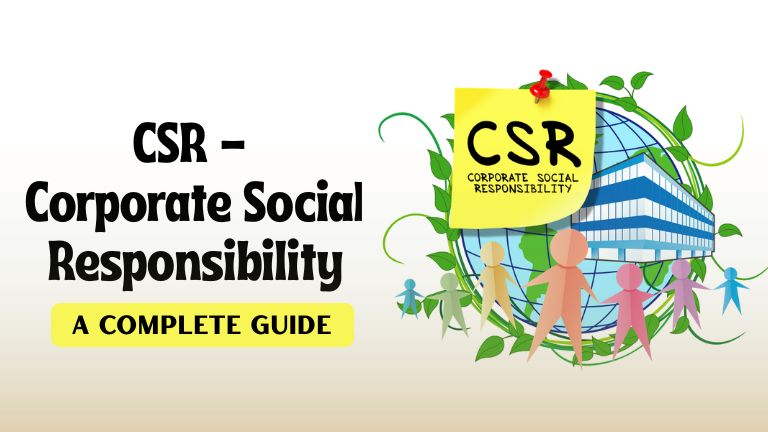
Companies in India have to do something called Corporate Social Responsibility. This means they have some statutory obligations towards the people and the planet. They have to make sure they are doing things in ethical way and helping people at the same time.
Meaning and Concept of CSR
Corporate Social Responsibility is when a company helps society. It is not about making money. Companies do things that help people and the earth.
Corporate Social Responsibility is, about giving back to society and making sure everyone is doing well. Companies that do Corporate Social Responsibility want to make sure they are helping people and doing things that’re good for everyone.
Legal Framework of CSR in India
CSR is governed by:
- Section 135 of the Companies Act, 2013
- Companies (CSR Policy) Rules, 2014 (amended from time to time)
India is the first country to legally mandate CSR spending.
Applicability of CSR Provisions
CSR provisions apply if a company meets any of the following criteria in the preceding financial year:
- Net worth ≥ ₹500 crore
- Turnover ≥ ₹1000 crore
- Net profit ≥ ₹5 crore
Once applicable, CSR provisions continue for 3 years even if thresholds are not met subsequently.
Calculation of Net Profit for CSR
- Net profit is calculated as per Section 198 of the Companies Act, 2013
- Excludes:
- Profits from overseas branches
- Dividends received from other CSR-compliant companies
- Average net profit of last 3 financial years is considered
CSR Committee – Composition, Roles & Functions
Composition
- Minimum 3 directors (including 1 independent director)
- Private companies (without independent director) can have 2 directors
- Foreign companies must have at least 2 persons
Roles & Functions
- Formulate CSR Policy
- Recommend CSR expenditure
- Identify and approve CSR projects
- Monitor implementation and utilization of funds
- Ensure compliance with CSR provisions
CSR Policy – Key Components
A CSR Policy must include:
- List of approved CSR projects
- Modalities of execution
- Monitoring mechanism
- Annual action plan
- Treatment of surplus arising out of CSR
CSR Activities under Schedule VII
CSR activities must align with Schedule VII, which includes:
- Eradicating hunger & poverty – food distribution, healthcare support
- Promoting education – schools, scholarships, digital learning
- Gender equality & women empowerment
- Environmental sustainability – afforestation, renewable energy
- Protection of national heritage & culture
- Rural development & slum area development
- Disaster management & relief funds
Modes of Undertaking CSR Activities
Companies can implement CSR through:
- Direct implementation
- Registered trusts, societies, or Section 8 companies
- Collaboration with other companies
- Government-approved funds
CSR Spending Requirements
- Minimum 2% of average net profits of last 3 years
- Administrative overheads capped at 5% of CSR expenditure
- Surplus from CSR activities must not form part of business profits
Treatment of Unspent CSR Amount
(a) Ongoing Projects
- Transfer to Unspent CSR Account within 30 days
- Utilise within 3 financial years
- If not utilised → transfer to Schedule VII Fund
(b) Other than Ongoing Projects
- Transfer to specified funds within 6 months of financial year end
Ongoing Projects
- Multi-year CSR projects (maximum 3 years excluding year of commencement)
- Must be approved by Board
- Require continuous monitoring and reporting
CSR Reporting and Disclosure
Companies must:
- Include CSR report in Board’s Report
- Disclose composition of CSR Committee
- Provide details of CSR spent and unspent
- Upload CSR policy on website
CSR Audit & Impact Assessment
- Impact assessment mandatory for companies with CSR obligation ≥ ₹10 crore (in certain cases)
- Conducted by independent agencies
- Helps evaluate effectiveness of CSR projects
Penalties for Non-Compliance
- Company penalty: Twice the unspent amount or ₹1 crore (whichever is less)
- Officer penalty: 1/10th of unspent amount or ₹2 lakh (whichever is less)
Practical Challenges in CSR Implementation
- Identifying genuine projects
- Monitoring fund utilization
- Measuring social impact
- Regulatory compliance burden
Best Practices for Effective CSR
- Align CSR with business strategy
- Focus on long-term projects
- Ensure transparency and reporting
- Partner with credible NGOs
- Conduct periodic impact assessments
Conclusion
Doing good for the community is now a law that companies in India have to follow. When companies do Corporate Social Responsibility effectively it makes a difference to the people and also makes the company look good, to everyone including the people who own a part of the company and the people who work with the company.
FAQs
Q1. What is CSR applicability threshold?
Net worth ₹500 crore, turnover ₹1000 crore, or net profit ₹5 crore.
Q2. How much should a company spend on CSR?
Minimum 2% of average net profits of last 3 years.
Q3. What is an ongoing project?
A multi-year CSR project undertaken by a company (up to 3 years).
Q4. Can CSR funds be used for employee benefits?
No, exclusive employee benefits are not allowed.
Q5. What happens to surplus from CSR activities?
It must be reinvested in CSR and cannot be treated as business profit.
Q6. Is CSR mandatory in India?
Yes, for eligible companies under Section 135.
Q7. Is impact assessment mandatory?
Yes, for certain companies meeting prescribed criteria.
ALSO READ
Change in Object Clause of a Section 8 Company
Top 6 Non-Compliance Risks for Section 8 Companies
How Section 8 Companies Can Raise Funds Legally
Who Can Start a Section 8 Company in India
Can a Section 8 Company Be Struck Off
Section 8 Company Registration Process Step By Step
Benefits of Section 8 Company Registration in India