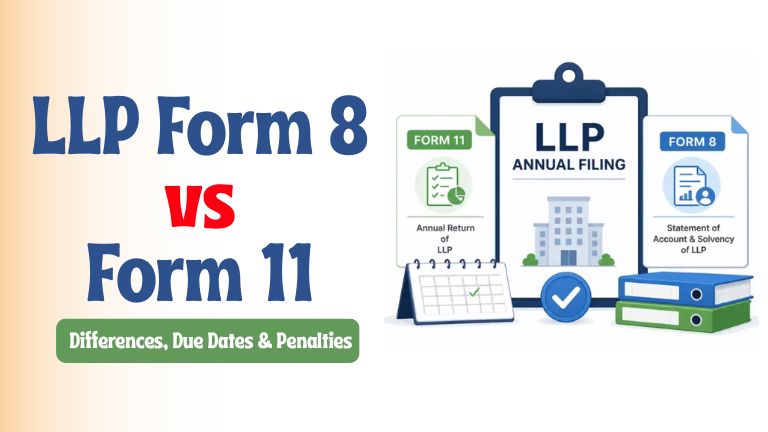
LLPs in India are governed by the Limited Liability Partnership Act, 2008 and the authority for administration of LLP Act lies with Ministry of Corporate Affairs (MCA). Although the LLPs have less compliance and more flexibility as compared to company but there are mandatory annual filing requirements for LLP also.
The following two filings are most important for LLPs:
- Form 8 – Statement of Account & Solvency
- Form 11 – Annual Return
In order to know about the penalties and compliance, it is important to know the difference between these two forms.
What is Form 8 of LLP?
Statement of Account & Solvency LLP Form 8 is an annual financial return to be filed by every LLP to the Ministry of Corporate Affairs under LLP Act, 2008.
It contains:
- Statement of Assets and Liabilities
- Statement of Income and Expenditure
- Declaration of Solvency by designated partners
It depicts the true and fair view of financial position and solvency of the LLP for a financial year.
Important Points:
- Mandatory for all LLPs (even if no business activity)
- Filed annually
- Due Date: 30th October
- Must be signed by at least 2 Designated Partners
Certification Required only if:
Turnover > ₹40 lakh, OR
Contribution > ₹25 lakh
Certification can be done by:
CA / CS / CMA
What is Form 11 of LLP?
LLP Form 11 (Annual Return) is a type of return that has to be filed by every LLP on the MCA Portal on an annual basis under the Limited Liability Partnership Act 2008.
It contains:
- Details of partners and designated partners
- Contribution of partners
- Changes in partners/management during the year
It describes the ownership and management structure of the LLP, and not its financial status.
Important Points:
- Applicable to all LLPs (including those with no business activity / NIL return)
- Due Date: 30th May every year
- Based on position as on 31st March
Certification
- No professional certification is required generally
- BUT if turnover exceeds ₹5 crore →
Form 11 is required to be certified by a Practising Company Secretary (PCS)
Key Differences Between Form 8 and 11
| Basis | Form 8 | Form 11 |
| Nature | Financial Statement | Annual Return |
| Purpose | Shows financial health | Shows ownership structure |
| Contents | Assets, liabilities, income, solvency | Partner details, contribution |
| Certification | CA certification required (if applicable) | Generally, not required |
| Filing Frequency | Annual | Annual |
| Applicability | All LLPs | All LLPs |
| Complexity | High | Low |
Deadline for submission of Form 8 & Form 11 in LLP
Form 11 Due Date:
- 30th May every year
- Covers details as on 31st March
Form 8 Due Date:
- 30th October every year
- Covers financial year ending 31st March
Important Note:
Even if your LLP:
- Has no transactions
- Is inactive
You STILL need to file both forms.
Fees for Late Submission
Failure to comply with LLP filings results in heavy fines.
Late Filing Fees:
- ₹100 per day
- No maximum limit
This makes LLP penalties very dangerous, especially if ignored for years.
Example:
If you delay filing forms for 1 year:
- ₹100 × 365 days = ₹36,500 (per form)
Total fess for both forms = ₹73,000
Additional Consequences:
- Disqualification risk of partners
- Difficulty in closing LLP
- Legal notices from MCA
- Increased compliance burden
Process of filing Form 11& Form 8
For LLP Form 11 (Annual Return)
- Collect details of partners/designated partners
- Prepare summary of contribution (as on 31st March)
- Login to MCA portal using LLP credentials
- Fill and upload Form 11 with required details
- Pay prescribed filing fees and submit
For LLP Form 8 (Statement of Account & Solvency)
- Prepare financial statements
- Get accounts audited if turnover > ₹40 lakh or contribution > ₹25 lakh (Audit by CA only)
- Certification required from CA / CS / CMA (as per applicability)
- Fill Form 8 including solvency declaration
- Upload on MCA portal and pay fees
Practical Advice on LLP Compliance
- Ensure accurate recording of all financial transactions throughout the year
- Timely filing of Form 11 and Form 8 to avoid penalties
- MCA portal issues / technical errors can cause delays and late fees
- Get accounts audited on time if turnover exceeds ₹40 lakh or contribution exceeds ₹25 lakh
- Consult CA / CS / CMA for accurate filing and compliance
- File NIL returns even if there is no business activity.
- Keep partner details updated in all filings.
Why is the LLP compliance being important?
Even though LLPs have fewer compliances than companies, ignoring them can:
- Increase financial burden
- Affect business credibility
- Create legal complications
Regular compliance ensures:
- Smooth operations
- Better funding opportunities
- Legal protection
Reasons to opt LLP as a Business Model?
LLP is the most recommended structure for the startups and professionals.
- Limited liability – The partners’ personal assets are not at risk for the business debts.
- Safer Compliances – LLP enjoy less compliances, no board meetings are required.
- Ease of Management – LLP Good simple structure and easy to take decision.
- Cost Effective – Less cost of incorporation and compliance than companies.
- Distinct legal entity- LLP can also own property & can sue or being sued in its own name.
- No Minimum Capital – LLP may be established with any amount of capital.
- Ideal for Professionals – Suitable for CA, CS, and consultancy firms due to flexibility.
Why Choose My Legal Business LLP for LLP Filings?
- Timely Submission- Submit on time and avoid any penalties and late fines.
- Competitive Charge– Services at affordable prices and clear costs.
- Hassle Free Filing– We do multiple checks on your tax returns so that the filing with IRS becomes hassle free.
- Turnaround Time– We process orders quickly so that you are never forced waiting till the last minute.
- Dedicated Support- You will have a single point of contact to lead you through any and all compliance questions.
- Compliance Notifications- Receive periodic email reminders for due dates.
- Trusted Service– Dependable and well recommended for the expanding LLP clientele.
Conclusion
Both Form 8 and Form 11 are mandatory annual compliance requirements for every LLP in India. Although Form 11 provides information about the ownership, Form 8 gives an insight into the LLP’s financial status. Non filing of these returns attracts a heavy penalty with no upper limit which compels the entities to timely comply with the same. If you’re after a simple, flexible, and inexpensive business structure, LLP is a great option – but only if compliance is taken seriously.
FAQs
1.Is Form 8 compulsory for all LLPs?
Yes, Form 8 has to be filed for all the LLPs even in case of no business activity.
2. Is Form 11 applicable for dormant LLPs?
Yes, you should submit Form 11 even if the LLP is not carrying on business.
3. What happens If LLP fails to file Form 8 and form 11?
A penalty of ₹100 per day is levied with no maximum limit for delay.
4. Can LLP file Form 8 without CA?
Yes, but certification is necessary if turnover is more than ₹40 lakh or if the contribution is more than ₹25 lakh.
5. Is it possible to revise Form 11 after submission?
No, you cannot revise Form 11 after filing.
6. When is the LLP Form 11 due date?
30th May of every year.
7. What is the LLP Form 11 due date?
30th October of every year.
8. Is a waiver of the late filing penalties available?
Generally, no; waiver is provided only in specific cases through government schemes.
9. Is audit mandatory for LLP?
Audit is mandatory only if turnover exceeds ₹40 lakh or contribution exceeds ₹25 lakh.
10. Can LLP be struck off for non-filing?
Yes, continuous non-compliance may lead to strike-off by authorities.
ALSO READ
How to Create and Integrate Your Bhaskar ID with Startup India Portal
Conversion of Private Limited Company into LLP