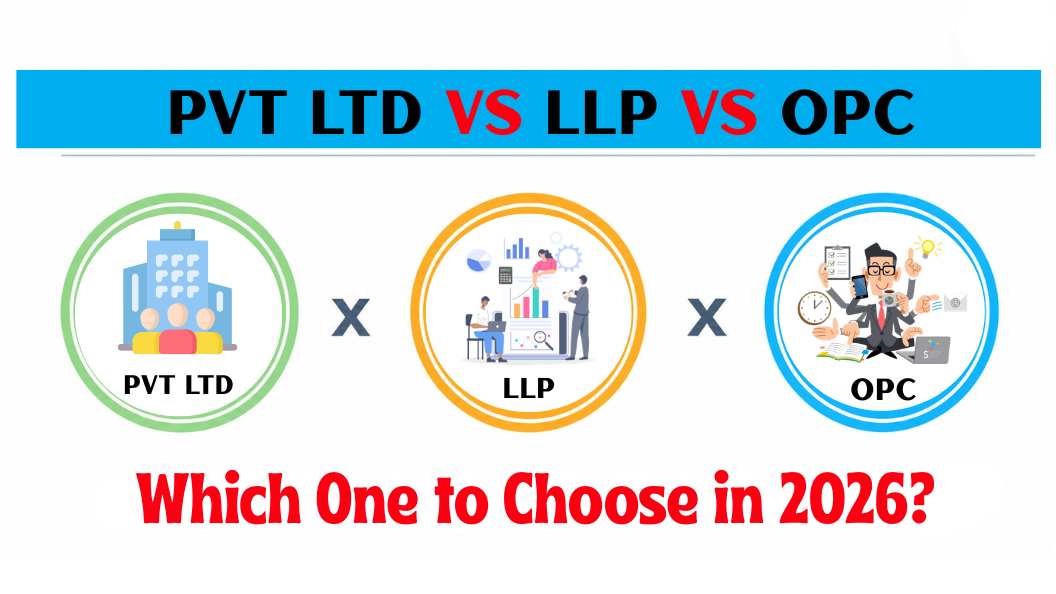
Selecting the appropriate form of business organization is crucial if you want your business to be successful and sustainable in the present and future. The type of business organization affects ownership, liability, tax, regulations, financing, and management.
There are three forms of businesses that are mostly adopted in India:
- Pvt Ltd
- LLP
- OPC
Each one of the above business organizations has its own strengths and weaknesses. You should therefore consider your business objectives, financial standing, and future prospects before making a decision.
The choice you make at the start of your business could go a long way in helping you avoid legal complications, complying with laws, and growing your business.
Meaning and legal nature
Private Limited Company (Pvt Ltd)
The private limited company is defined as a company incorporated in accordance with the Companies Act, 2013. A shareholder’s membership and his status as a company under the law are distinct from each other because the company is an independent legal entity. It was capable of acquiring property in its name, contracting obligations, and suing and being sued. The responsibility of the shareholders will extend only up to the extent of the unpaid share capital.
Limited Liability Partnership (LLP)
The Limited Liability Partnership is governed by the LLP Act, 2008. It is considered to be a unique form of business organization which shares similarities with both a firm and a company. There is a limit on the liability of its partners and has an independent legal personality. Its operation is flexible, and its internal affairs are governed by the LLP Agreement.
One Person Company (OPC)
The one person company (OPC) is a type of company registered under the Companies Act, 2013 with just one member. It has got the advantages of separate legal entity and limited liability for a single entrepreneur. OPC is an ideal solution to motivate the individual entrepreneurs to do business in concentration.
Main Characteristics of Each Structure
Pvt Ltd Company
- Minimum 2 shareholders, maximum 200
- Directors required: Minimum 2
- Separate legal entity
- Mandatory audit
- Easy transfer of ownership through shares
- Suitable for funding and scalability
LLP
- Minimum 2 partners (no upper limit)
- Separate legal entity
- Limited liability for partners
- Less compliance
- Governed by LLP Agreement
- No concept of shares
OPC
- Single owner
- One nominee required
- Separate legal entity
- Mandatory conversion if threshold exceeded
- Restricted business expansion
Comparison in Detailed Table
| Particulars | Pvt Ltd | LLP | OPC |
| Governing Law | Companies Act, 2013 | LLP Act, 2008 | Companies Act, 2013 |
| Members | 2–200 | Min 2 partners | 1 |
| Liability | Limited | Limited | Limited |
| Compliance | High | Low | Medium |
| Audit | Mandatory | Conditional | Mandatory |
| Taxation | 22% (approx.) | 30% (approx.) | 22% (approx.) |
| Funding | Easy (equity) | Difficult | Very limited |
| Ownership Transfer | Easy | Complex | Not possible |
| Ideal For | Startups | SMEs | Solo entrepreneurs |
In-depth Analysis
1. Compliance Burden
- Pvt Ltd: Annual compliance, annual meeting, statutory audit – HIGH
- LLP: Minimal compliance required (forms 8 and 11) – LOW
- OPC: Moderate compliance but simpler than Pvt Ltd
2. Cost of Formation & Maintenance
- Pvt Ltd: Higher due to compliance & professional fees
- LLP: Cost-effective
- OPC: Moderate
3. Taxation
- Pvt Ltd & OPC: Corporate tax rates apply
- LLP: Uniform tax rate of 30% without dividend tax
4. Financing & Investment
- Pvt Ltd: Option to raise money via equity, venture capital, and angel investors
- LLP: Cannot issue shares
- OPC: Not preferred by investors
5. Ownership & Control
- Pvt Ltd: Shared ownership
- LLP: Flexible internal structure
- OPC: Complete control with one person
6. Scalability
- Pvt Ltd: Highly scalable
- LLP: Limited scalability
- OPC: Needs conversion for growth
Advantages & Disadvantages
Private Limited Company (Pvt Ltd)
Advantages:
- Easy access to funds from investors, venture capital firms and banks
- High level of trust and dependability among customers and shareholders
- Separate legal entity with limited liability protection
- Easy transfer of ownership through shares
Disadvantages:
- Bars for compliance are high (ROC filings, board meetings, audit)
- More expensive to incorporate and maintain
- Rigid regulatory framework
Limited Liability Partnership (LLP)
Advantages:
- Low compliance burden compared to companies
- Flexible internal management structure
- Cost-effective formation and maintenance
- Limited liability protection for partners
Disadvantages:
- Cannot raise equity funding (no share capital)
- Limited growth opportunities compared to companies
- Transfer of ownership is comparatively complex
One Person Company (OPC)
Advantages:
- Single ownership with full control over business decisions
- Limited liability protection
- Separate legal identity
- More suitable for entrepreneurs and small-scale businesses.
Disadvantages:
- Restrictions on growth and expansion
- Mandatory conversion into Pvt Ltd after crossing threshold limits
- Limited funding opportunities
- Not suitable for scaling startups
When Should You Choose Each?
Opt for Pvt Ltd if:
- You are building a startup
- You need funding from investors
- You plan rapid expansion
Opt for LLP if:
- You run a small/medium business
- You want low compliance
- You are a professional (CA, CS, lawyer, consultant)
Opt for OPC if:
- You are a freelancer or solo founder
- You want legal identity without partners
Why to Choose My Legal Business LLP ?
Choosing the right consultant is as important as choosing the right structure.
My Legal Business LLP offers:
- Expert consultation tailored to your business
- Fast company/LLP/OPC registration
- Complete compliance support
- MCA filings, GST and Legal drafting assistance
- Dedicated support team
- Trusted by startups and professionals
We don’t just file paperwork for your business — we help you build it on a foundation of ironclad legal protection from the start.
Conclusion
What type of business entity is best being a question that doesn’t have a simple answer, and the suitability of each type will depend on your specific business requirements and what you envision for your business in the future
Each type has its own advantages:
- A Private Limited Company (Pvt Ltd) is suitable for the kind of business that expects growth, wants to be scalable and is likely to seek funding from the outside world.
- Limited Liability Partnership (LLP) works well for people who want flexibility and low compliance and costs.
- One Person Company (OPC) is most beneficial for a single entrepreneur who is looking for limited liability protection with full ownership.
In case you are confused in the beginning stage, you can opt for an LLP, as it is easy to maintain and has fewer compliances. But if what you want is to grow and raise funds for your business later on, it would be more prudent to begin with a Private Limited Company.
FAQs
1. What is the best type of company for startups?
Due to its easy fund-raising methods, scalability and more trustworthiness, a Private Limited Company is the most preferred option for startups by far.
2. Is LLP better than OPC?
Yes, LLP is preferable when two or more partners are involved and it has more flexibility in management as compared to OPC.
3. Can an OPC hire employees?
Yes, an OPC can hire employees as per its business requirements.
4. GST registration: Is it mandatory for an LLP?
GST registration can be obtained only on crossing the turnover limit or getting into the category of mandatory registration for business.
5. Can LLP be converted to a Private limited Company?
Yes, it is possible to convert an LLP into a Private Limited Company as per the legal procedure prescribed under the applicable laws.
6. Which structure is the least costly to comply with?
LLP is the most economical in terms of cost and compliances, as compared Pvt Ltd and OPC.
7. Can foreign investors invest in an LLP?
Yes, foreign participation is permitted in the LLPs, subject to certain conditions and regulatory approvals.
8. Do we have to audit an OPC?
Yes, an OPC must undertake a statutory audit, irrespective of its turnover
9. Which structure provides maximum control?
OPC provides maximum control as it is owned and managed by a single individual.
10. Why should choose My Legal Business LLP?
My Legal Business LLP is the best business formation option, as it provides us with a chance to profit its professional advice at a minimal expense level with a full coverage from legal and compliance perspective in the business set-up and its development.
ALSO READ
What to Do If Your DIN is Deactivated
How to Create and Integrate Your Bhaskar ID with Startup India Portal
How to Raise Donations for a Section 8 Company
Form 145 and 146 Replace 15 CA and 15 CB from April 2026