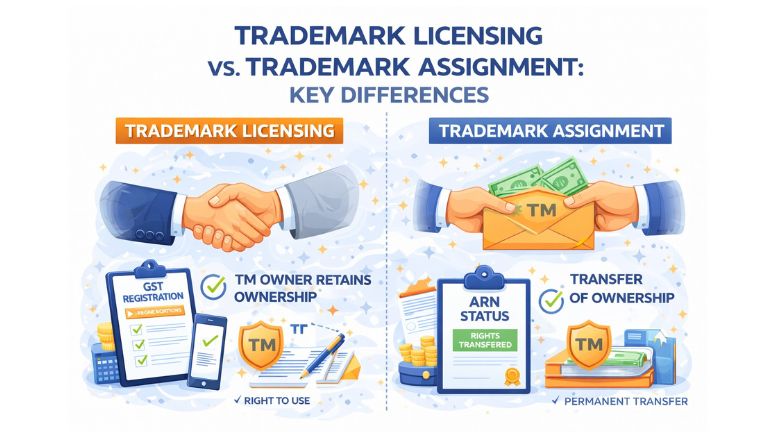
Understanding the difference between Trademark Licensing vs. Trademark Assignment is essential for businesses and brand owners in India. While both processes involve the use of a registered trademark, they serve different legal and commercial purposes. Trademark Assignment transfers ownership of the trademark from one party to another, whereas Trademark Licensing allows a party to use the trademark without transferring ownership. Making the right choice ensures proper protection of brand value and avoids potential legal disputes.
This blog covers the definitions, key differences, legal provisions, common mistakes, and practical examples of Trademark Licensing vs. Trademark Assignment to help businesses make informed decisions and safeguard their intellectual property.
What is a Trademark Assignment?
A Trademark Assignment under the Trade Marks Act, 1999 is the legal process by which the ownership of a registered trademark is transferred from one party (the assignor) to another (the assignee). Once assigned, all rights, title, and interest in the trademark pass to the new owner, giving them full control over its use and enforcement. Assignments can be total or partial, and may include goodwill associated with the trademark. Proper execution and registration with the Trademark Registry are essential to make the assignment legally valid and enforceable in India, ensuring the assignee’s exclusive rights over the mark.
What is a Trademark Licensing?
Trademark Licensing under the Trade Marks Act, 1999 is an agreement in which the trademark owner (licensor) permits another party (licensee) to use the registered trademark for specific goods or services without transferring ownership. The licensor retains full rights and control over the trademark, while the licensee gains the right to use it under agreed terms. Licensing can be exclusive or non-exclusive, often involving royalty payments. This arrangement allows businesses to expand brand presence, generate revenue, and maintain legal protection, making it a strategic tool alongside Trademark Assignment.
Trademark Licensing vs. Trademark Assignment: Key differences
The table below highlights the key differences between Trademark Licensing vs. Trademark Assignment under the Trade Marks Act, 1999, helping businesses understand ownership, rights, and legal implications of Trademark Licensing and trademark assignment.
| Feature | Trademark Assignment | Trademark Licensing |
| Definition | Transfer of ownership of a registered trademark to another party. | Permission to use a registered trademark without transferring ownership. |
| Ownership | Ownership changes to the assignee. | Ownership remains with the licensor. |
| Rights | Assignee gets full rights and control over the trademark. | Licensee gets only the right to use the trademark as per agreement. |
| Goodwill | Can include goodwill of the business. | Goodwill generally remains with the licensor. |
| Registration | Must be registered with the Trademark Registry to be valid. | Registration is optional but recommended for enforceability. |
| Duration | Usually permanent unless agreed otherwise. | Usually limited to the agreed period in the license agreement. |
| Purpose | Complete transfer of trademark for strategic or commercial reasons. | Expanding brand use, generating revenue, or marketing without losing ownership. |
Understanding these differences in Trademark Licensing vs. Trademark Assignment ensures informed decisions for effective brand protection.
Trademark Licensing vs. Trademark Assignment: Key Benefits Compared
The table compares the key benefits of Trademark Licensing vs. Trademark Assignment to help businesses make informed decisions.
| Benefit | Trademark Assignment | Trademark Licensing |
| Ownership & Control | Full ownership and control transfer to assignee. | Owner retains control while allowing usage by licensee. |
| Revenue Potential | One-time or structured payment for assignment. | Continuous revenue through royalties or fees. |
| Brand Expansion | Assignee can independently grow and exploit the brand. | Licensor can expand brand reach without losing ownership. |
| Legal Clarity | Clear transfer of rights reduces future disputes. | Licensing agreement defines scope, duration, and usage, minimizing legal risks. |
| Strategic Flexibility | Ideal for mergers, acquisitions, or complete sale of business. | Useful for marketing, collaborations, or limited-term projects. |
Choosing the right approach ensures maximum brand value, legal protection, and strategic growth in India.
Real-World Examples of Trademark Licensing vs. Trademark Assignment
- Trademark Assignment Example: When PepsiCo sold its Tropicana brand in India to a local company, the ownership of the trademark was fully transferred. The new company gained complete control over the brand, demonstrating a clear case of Trademark Assignment.
- Trademark Licensing Example: Coca-Cola often allows bottling companies to use its trademark under licensing agreements. The bottlers can sell beverages using the Coca-Cola brand, but the ownership remains with Coca-Cola, illustrating Trademark Licensing.
These examples show how Trademark Licensing vs. Trademark Assignment helps businesses expand, monetize, or transfer brand rights strategically under the Trade Marks Act, 1999.
Common Mistakes to Avoid in Trademark Licensing vs. Trademark Assignment
- Confusing Licensing with Assignment – Understand that assignment transfers ownership, while licensing only permits use.
- Incomplete or incorrect agreements – Always draft detailed, legally compliant contracts specifying rights, duration, and obligations.
- Failure to register assignments – Trademark Assignment must be recorded with the Trademark Registry to be legally valid.
- Unauthorized sublicensing – Ensure licensing agreements clearly state whether sublicensing is allowed.
- Ignoring goodwill transfer – In assignment, include goodwill to avoid disputes; in licensing, clarify ownership of goodwill.
- Non-compliance with statutory provisions – Follow the Trade Marks Act, 1999 for both assignment and licensing.
Conclusion
Understanding the distinction between Trademark Licensing vs. Trademark Assignment is essential for businesses aiming to protect, commercialize, or transfer their brand assets effectively. While trademark assignment results in a complete transfer of ownership, trademark licensing allows controlled use of the trademark without giving up ownership rights. Each mechanism serves a different strategic purpose and must be chosen based on business objectives, risk appetite, and long-term brand plans.
Incorrect structuring of trademark licensing or assignment can lead to ownership disputes, loss of brand value, or enforcement challenges. Compliance with the Trade Marks Act, 1999, proper documentation, and timely registration are crucial to ensure legal validity and protection. Businesses must also clearly define rights, goodwill, duration, and territorial scope to avoid ambiguity and future conflicts.
At My Legal Business LLP, we provide end-to-end professional assistance in Trademark Licensing and Trademark Assignment, including drafting and vetting agreements, advisory on goodwill and ownership transfer, filing with the Trademark Registry, and ensuring full statutory compliance. Our services are tailored for startups, established businesses, and professionals seeking legally sound and commercially effective trademark solutions, enabling smooth transactions and long-term brand protection.
ALSO READ
Top 10 Trademark Mistakes Every Indian Start-Up Must Avoid
Trademark Registration in India: Mandatory or Not
How to Register a Trademark for a Cloud Kitchen in India
Trademark Registration for Sole Proprietorship