Are you planning to incorporate One Person Company Registration (OPC) in India? The good news is that the process in 2025 is simpler, faster, and more founder-friendly than ever before. With the OPC model, you can enjoy the advantages of running a company with limited liability and official corporate recognition, while still keeping complete control of your business decisions. 2021 MCA reforms have removed old restrictions, giving solo entrepreneurs more flexibility, smoother compliance, and easier conversion options in the future.
One Person Company Registration can help you achieve the best outcomes, whether you are a consultant wishing to formalize your firm, a freelancer looking to grow, or an ambitious entrepreneur searching for legitimacy and financing and funding options.
In this blog, we will walk you through thestep-by-step process of One Person Company Registration in India, highlight the documents you need, explain the timelines, and point out common mistakes you should avoid. By the end, you will know everything about One Person Company Registration and kick-start your entrepreneurial journey with confidence.
One Person Company Registration Eligibility Criteria
Before opting for One Person Company Registration in India, it is important to check whether you meet the eligibility requirements set under the Companies Act, 2013 and the latest MCA rules. The table below highlights the key criteria you must fulfil for a smooth One Person Company Registration in 2025.
| Eligibility Requirement | Details |
| Natural Person and Citizenship | Only a natural person (individual) who is an Indian citizen can opt for One Person Company Registration. The applicant must be a resident in India, defined after the 2021 amendment as someone who has stayed in India for at least 120 days in the preceding financial year. Foreign citizens, NRIs (except where specifically permitted), and legal entities are not eligible. |
| One OPC Per Person | An individual can incorporate only one OPC at a time. Similarly, the same individual can act as a nominee in only one OPC. This prevents multiple One Person Company Registrations under a single name. |
| Nominee Appointment | It is compulsory to appoint a nominee during incorporation. The nominee must also be an Indian citizen, a resident in India, and a natural person. In case of death or incapacity of the member, the nominee becomes the owner. Written consent of the nominee in Form INC-3 must be filed with the Registrar of Companies. |
| Minimum Capital Requirement | There is no mandatory minimum paid-up capital for forming an OPC. The authorised capital can be decided by the founder based on business requirements. Earlier restrictions such as ₹1,00,000 minimum capital have been removed. |
| Single Member and Director | An OPC can have only one shareholder, who may also serve as the sole director. The law allows appointment of up to 15 directors if required, with shareholder approval. |
| Restrictions on Activities | One Person Company Registration is not permitted to conduct Non-Banking Financial Investment activities, banking, insurance, or similar regulated businesses. They also cannot be registered or converted as Section 8 companies (non-profits). |
| Other Conditions | The registered office of the OPC must be in India. The sole member must be at least 18 years old and legally competent to contract. Except for exempted provisions, the Companies Act, 2013 applies to OPCs in full. To get the full list of exemptions available to One Person Company, read our article titled Benefits of OPC Registration. https://www.mylegalbusiness.com/blog/benefits-of-opc-registration-for-solo-entrepreneurs/ |
Documents Required for One Person Company Registration
Before you begin the process of One Person Company registration, it is important to keep all the required documents ready. These documents verify the identity of the member and nominee, establish the validity of the registered office, and form the legal foundation of the company. A simplified checklist of One Person Company Registration is given below for quick reference: –
| Category | Documents Needed |
| Identity and Address Proof of Sole Member/Director | PAN Card (mandatory) Aadhaar Card (for e-KYC and MCA portal authentication)One Government-issued ID Proof (Voter ID, Passport, or Driving License)Recent passport-size photograph Residential address proof (bank statement, utility bill, or mobile/telephone bill not older than 2 months) |
| Nominee’s Identity and Consent | PAN Card and Aadhaar Card Residential address proofForm INC-3 (nominee’s written consent, mandatory at incorporation) Recent photograph and ID proof Nominee must be an Indian citizen and resident in India From July 14, 2025, Form INC-3 will be available on MCA V3 portal for faster filing |
| Proof of Registered Office | Utility bill, property tax receipt, or similar document (not older than 2 months) Rent agreement (if premises are rented) No Objection Certificate (NOC) from property owner Address must match details in SPICe+ Part B and AGILE-PRO-S forms |
| Constitutional and Legal Documents | Memorandum of Association (MOA) via e-MOA Form INC-33Articles of Association (AOA) via e-AOA Form INC-34Form DIR-2 (consent to act as director) Form INC-9 (declaration by director/subscriber, auto-generated in SPICe+) Specimen signature (for official records and bank/DIN verification if required) |
| Digital and Professional Requirements | Class 3 Digital Signature Certificate (DSC) of sole member/director and of nominee Professional certification in Form INC-8 by CA, CS, Cost Accountant, or Advocate |
| Other Applicable Documents (If required) | Proof of nationality (for NRI/foreign citizen applicants if eligible) Authorisation documents like board resolution or power of attorney (for corporate subscriptions) Certified translations for any non-English or non-Hindi documents |
Step-By-Step Registration Process of One Person Company in India
Are you looking to register a One Person Company in India? Here is the step-by-step process of One Person Company Registration.
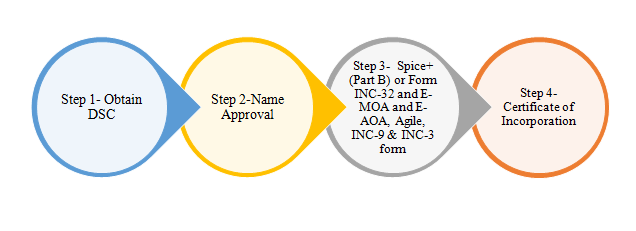
Step 1: – Obtain Digital Signature Certificate (DSC)
Step 2: – Name Approval (Form Spice+Part A)
Step 3: – Spice+ Part B or Form INC-32 along with E-MOA and E-AOA with Agile, INC-9 and INC-3 Form
Step 4: – Certificate of Incorporation
STEP 1: – Obtain DSC (Digital Signature Certificate)
The first step-in One-Person Company Registration is to obtain Digital Signature Certificate. [DSC].Since the entire registration process of one person company is online, DSC is mandatory for signing electronic documents submitted to the Ministry of Corporate Affairs (MCA).
The proposed subscriberto the Memorandum of Association (MOA) and Articles of Association (AOA) and nominee of OPC must obtain a valid Class 3 DSC from a government-recognized certifying authority.
Bonus Tip: Apply for your DSC early to avoid delays in the registration process of One PersonCompany. You’ll need it throughout the registration process of One Person Company and for future ROC filings as well.
STEP 2: -Name approval
The second step in registration process of One person company is to get name approved from Ministry of Corporate Affairs (MCA).
There are 2 options available to get the name approved from MCA.
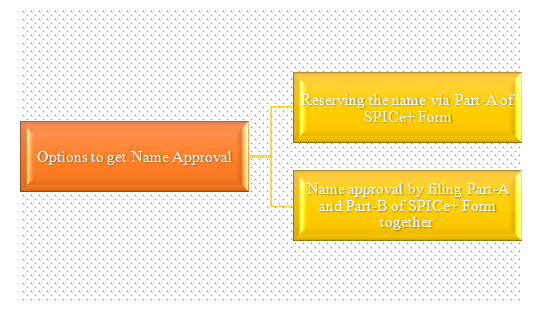
Option 1: – Reserving the name via Part-A of SPICe+ Form
Option 2: – Name approval by filing Part-A and Part-B of SPICe+ Form together
The details of name approval process can be checked on our article: –
Step 3: – Filing of Spice+ form – Part B – (INC-32)
The third step-in One-Personcompany Registration is to file Spice+ form -Part B (INC-32).
Part-B of the SPICe+ (INC-32) form is the core component of the One Person Company registration process in India, enabling a web-based, integrated, and streamlined application for multiple mandatory registrations in one go. This digital process is designed to simplify incorporation and reduce paperwork for new businesses.
With a single SPICe+ application, you can apply for:
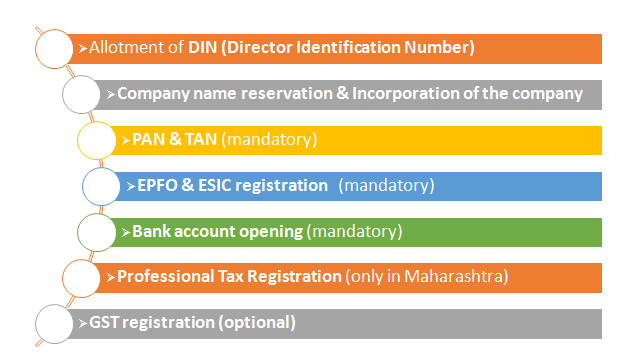
The important point in registration process of One Person Company is to note here is that there OPC requires asinglesubscriber and one director, and the sole subscriber can also act as the director of the company. In case, the sole subscriber wants to appoint more directors, the company law allows appointment of maximum of 15 directors on the board. DIN (Director Identification Number) is automatically allotted to the three directorsthrough the SPICe+ (INC-32) form.If more than three directors don’t have DIN, the company must be incorporated with three directors, and others can be added later via MCA filings.
The SPICe+ form also allows real-time data validation, and once Part-A and Part-B are completed, the information auto-populates linked forms such as AGILE-PRO, E-MOA, E-AOA, INC-9, and others as applicable.
The Electronic Memorandum of Association (E-MOA) and Electronic Articles of Association (E-AOA) must be filed as part of the One Person Company registration process. The Ministry of Corporate Affairs (MCA) introduced these digital forms, which streamline and digitize the documentation procedure.
While the E-AOA describes the company’s internal policies, duties, and governance framework, the E-MOA establishes the goals and parameters of the business. Electronically submitting these forms expedites the approval procedure and guarantees adherence to the 2013 Companies Act.
As part of One Person Company registration, it is mandatory to appoint a nominee who will take charge in case the sole member or director is unable to continue due to death or incapacity. The nominee’s consent must be filed in Form INC-3 along with identity proofs such as PAN and Aadhaar card, making it a crucial document for One Person Company incorporation.
All these forms must be downloaded in PDF, digitally signed (DSC) by the applicant(s) and a professional certifier (Chartered Accountant, Company Secretary, Cost Accountant, or Advocate), and then submitted online for approval.
Step 4: – Certificate of Incorporation
Getting a Certificate of Incorporation is the fourth and last step in the One Person Company registration procedure.
The Registrar of Companies (ROC) issues the Certificate of Incorporation (COI) and the Company Identification Number (CIN) upon the submission and approval of the SPICe+ form. The company’s PAN and TAN, which are automatically generated and provided by the Income Tax Department, are also included in this certificate.
Digital copies of the PAN and TAN are supplied by email with the certificate of incorporation.
Opening a bank account, obtaining licenses, signing contracts, and legally starting a business all depend on the Certificate of Incorporation.
The issuance of the Certificate of Incorporation completes the registration process of One Person company and empowers the promoter to begin business as a legally recognized entity.
One Person Company Registration Timeline
One Person Company registration is now a streamlined process in India. On average, it takes about 14 to 21 working days if all documents are accurate and there are no objections from the Registrar of Companies (ROC). A stage wise One Person Company registration timeline is given below for your quick reference: –
| Stage | Estimated Time Required |
| Digital Signature Certificate (DSC) | 1 working day |
| Name Reservation (SPICe+ Part A) | 2-3 working days |
| Document Drafting and Signing | 1-2working days |
| Filing SPICe+ and Linked Forms | 1 working day |
| ROC Processing and Approval | 2–3 working days |
| PAN, TAN, and Certificate of Incorporation (COI) | Issued along with final ROC approval |
| Total Registration Time | Approximately 07 to 10 working days |
Note: The timeline may extend if documents are incomplete, the proposed name gets rejected, or additional queries are raised by the Ministry of Corporate Affairs (MCA). The name of the company shall end with OPC Private Limited. To choose the perfect name, please refer our article:-
Pro Tips to Avoid Delays in One Person Company Registration
- Make sure KYC documents are recent and not older than 60 days.
- Confirm nominee details and consent in Form INC-3 before applying.
- Do a quick company name and trademark search to avoid rejection.
- Get expert guidance for drafting, filing, and certification of forms.
- Keep an eye on the MCA V3 portal and reply quickly to any ROC queries.
Conclusion
One Person Company Registrationis not merely a compliance requirement; it is a strategic decision that provides credibility, legal protection, and growth opportunities to individual entrepreneurs. With the relaxation of capital and turnover limits, OPCs today offer a highly flexible structure that allows founders to expand their businesses while maintaining full ownership and control.
This blog has outlined the key aspects of One Person Company Registration including eligibility, required documents, filing process, fees, and timelines. For freelancers, consultants, and solo innovators, the OPC model combines the benefits of limited liability with the simplicity of single ownership. At the same time, accuracy in filings and timely compliance remain essential for long-term success, and professional assistance can significantly reduce the chances of delays or errors.
In essence, One Person Company registration is a foundation for building a legally recognized and sustainable business. With careful preparation and proper execution, a one-person enterprise can grow steadily and evolve into a larger and more established organization in the future.
ALSO READ
Limited Liability Partnership Registration Process in India
Conversion of LLP into a Private Limited Company in India
Benefits of OPC Registration For Solo Entrepreneurs
Key Highlights of the Online Gaming Bill 2025
Difference Between One Person Company and Sole Proprietorship