

Are you thinking about taking your partnership firm to the next level? Conversion of Partnership Firm into LLP has become one of the most preferred choices for businesses that want growth, flexibility, and legal security. Unlike traditional firms, an LLP provides the benefits of limited liability protection for partners, recognition as a separate legal entity, the freedom to have an unlimited number of partners, and a smoother process for transferring ownership. Introduced under the Limited Liability Partnership Act, 2008, the LLP structure has quickly emerged as the go-to option for small and medium enterprises seeking a modern, compliant, and business-friendly framework in India.
In this blog, we shall guide you through the key features of the LLP structure, its practical advantages, the step-by-step process for conversion of Partnership Firm into LLP, along with the required documents, estimated timeline, and cost, helping you decide whether this transition aligns with your professional goals.
Key features of LLP and its Practical Benefits
When comparing a traditional partnership with a Limited Liability Partnership (LLP), the LLP model clearly stands out for offering modern features that combine flexibility with legal and financial security. The table below outlines key features of LLP along with its practical benefits: –
| Feature | Practical Benefits of LLP |
| Legal Status | LLP is recognized as a separate legal entity, ensuring continuity even if partners change. |
| Liability of Partners | Partners’ liability is limited to their agreed contribution, protecting personal assets. |
| Number of Partners | There is no maximum limit on partners, offering scalability and flexibility for expansion. |
| Ownership Transfer | Easy transfer of ownership rights, making restructuring or adding new partners seamless. |
| Compliance & Transparency | LLP is regulated under the LLP Act, 2008 with statutory filings, enhancing credibility with banks and clients. |
| Perpetual Succession | LLP continues irrespective of changes in partners, ensuring long-term stability. |
| Funding Opportunities | LLP has better acceptance by investors and financial institutions due to structured governance. |
| Taxation | LLP is taxed like a partnership firm but enjoys the advantage of a corporate-style structure. |
| Professional Image | LLP is viewed as a modern, corporate-friendly entity that boosts brand credibility. |
With its blend of limited liability protection, ease of management, and credibility, an LLP emerges as the smarter and more future-ready alternative to the traditional partnership structure in India.
Who Should Consider Conversion of Partnership Firm into LLP?
- Professional service firms (CA, CS, Legal practices)
- Trading and manufacturing partnerships
- Consulting and advisory businesses
- Family businesses seeking structure
- Growing partnerships needing limited liability
When Conversion of Partnership Firm into LLP should be planned?
- Business growth requiring external funding – Conversion can be planned when the firm needs access to bank loans, venture capital, or private equity to fuel expansion.
- Need for limited liability protection – When partners wish to protect their personal assets from business debts and risks, conversion becomes the right choice.
- Expansion plans requiring separate legal entity – If the business aims to scale across states or countries, a recognized legal entity like an LLP is essential.
- Succession planning requirements – Conversion is useful when partners want a smooth transfer of ownership or continuity of business across generations.
- Enhanced credibility needs with clients/vendors – Businesses dealing with corporates, government projects, or large vendors may convert to LLP for improved trust and professional image.
Key Conditions for Conversion of Partnership Firm into LLP
- The partnership firm must have at least 2 partners at the time of conversion and all existing partners must consent to the conversion process.
- All the partners of the partnership firm at the time of conversion must become partners in LLP.
- All the designated partners must acquire DIN and at least one Designated partner shall be Indian Resident.
- The partnership firm’s business activities must be legally permissible for LLPs.
- The consent of all the creditors shall be obtained.
- All the Compliances of Partnership Firm relating to Income tax filings shall be duly completed and Partnership accounts should be up-to-date and properly maintained in such a way that no outstanding dues or penalties that could hinder conversion.
Documents Required for Conversion of Partnership Firm into LLP
- Partnership Deed – Original Copy of Partnership Deed
- PAN Card of the partnership firm and all partners
- Address Proof of registered office
- Identity Proof of all partners
- Bank Statements and financial records
- Tax Returns for the last 3 years
- Consent Letters from all partners
- Audited financial statements
- List of assets and liabilities
- Details of pending contracts and agreements
- Insurance policies and their transfer documentation (if any)
- Intellectual property registrations (if any)
Step- By- Step Process of Conversion of Partnership Firm into LLP
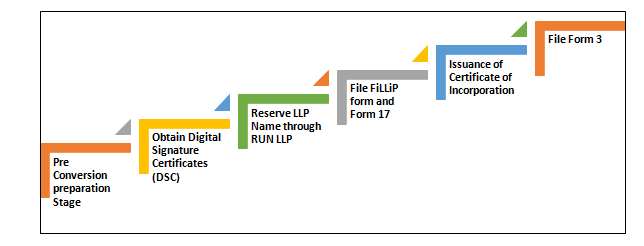
Step 1: – Pre Conversion Preparation Stage: – Before initiating the process of conversion of Partnership Firm into LLP, it is important to ensure proper planning and groundwork. A well-prepared approach helps in smooth compliance and avoids unnecessary delays. Below are the key preparations every partnership firm should make:
- Review the Partnership Agreement
- Obtain Partners’ Consent
- Decide on Partners and Designated Partners
- Conduct due diligence of partnership affairs
- Prepare necessary documentation
- Clear outstanding compliances
Step 2: – Obtain Digital Signature Certificates (DSCs): – The second step is to obtain a Digital Signature Certificate (DSC) for all designated partners during the conversion of Partnership Firm intoLLP. Since MCA filings are completely online, a valid DSC is required to digitally sign incorporation forms and other compliance documents
Securing DSCs in advance helps avoid delays and ensures a seamless LLP conversion process.
Step 3: – Reserve LLP Name through RUN LLP: – The third step is to reserve a unique name for your LLP through the RUN-LLP (Reserve Unique Name) service on the MCA portal for conversion of Partnership Firm into LLP. The proposed name must comply with MCA guidelines and should ideally reflect the existing brand identity of the firm. Once approved, the reserved name remains valid for 90 days during which the LLP incorporation process must be completed. Timely name reservation ensures smooth filing and avoids rejection or delays in conversion.
Step 4: – File FiLLiP form along with Form 17: – The fourth and most important step is to file FiLLiP form for conversion of Partnership Firm into LLP.Form FiLLiP (Form for Incorporation of Limited Liability Partnership) is the primary application form required for converting a Partnership firm into a Limited Liability Partnership (LLP) under the Limited Liability Partnership Act, 2008. This integrated form allows partners to apply for LLP incorporation, reservation of name (if not already done through RUN-LLP), and allocation of DIN/DPIN for designated partners in a single step. Essential details such as partner information, registered office address, business activity, and attachments like the partnership deed and consent letters are submitted through FiLLiP. Properly completing this form ensures a smooth and legally compliant conversion of Partnership firm into LLP
Further, Form 17 is an e-form under the Companies Act, 2013, filed on the MCA portal to convert a Limited Liability Partnership (LLP) into a Private Limited Company under Section 366 of the Companies Act, 2013. It must be submitted with supporting documents such as the consent of partners, list of members and directors, certificate from a professional, and incorporation details.
Filing Form 17 ensures a legally valid conversion, provides corporate recognition, and enables the new company to raise equity funding, enhance credibility, and expand business opportunities.
Step 5: – Issuance of Certificate of Incorporation: – The Certificate of Incorporation is the final approval issued by the Ministry of Corporate Affairs (MCA) upon successful conversion of a Partnership Firm into an LLP. This certificate acts as conclusive proof of the LLP’s legal existence, mentioning the LLP Identification Number (LLPIN) and the date of incorporation. Once issued, the partnership firm stands dissolved, and all its assets, liabilities, and business operations automatically vest in the newly formed LLP although the PAN of LLP remains same as of the Partnership firm.
The Certificate of Incorporation is a crucial document for commencing operations, opening bank accounts, and ensuring statutory compliance under the LLP Act.
Step 6: – File Form 3: – The next and last step is filing of Form 3 with the Ministry of Corporate Affairs (MCA) after the conversion of a Partnership Firm into an LLP. It is used to submit the LLP Agreement, which defines the rights, duties, and obligations of partners as well as the management structure of the LLP. Filing Form 3 within 30 days of incorporation is a legal requirement, and non-compliance may lead to penalties. This form ensures that the LLP operates with a clear, legally recognized framework.
Estimated Timeline for Conversion of Partnership Firm into LLP
Conversion of Partnership Firm into LLP is a structured legal process governed by the Companies Act, 2013. The timeline for conversion largely depends on document readiness, approvals from all partners, and MCA processing. The estimated timeline is given below: –
| Stage | Process Involved | Estimated Time |
| Step 1 | Deep scrutiny by professional regarding all compliances of Partnership Firm | 5–7 days |
| Step 2 | Name approval application with MCA | 5–7 days |
| Step 3 | Filing FiLLip and Form 17 | 5– 7 days |
| Step 4 | Scrutiny by Registrar of LLP resubmission (if any) | 5–7 days |
| Step 5 | Grant of Certificate of Incorporation | 1-2 days |
Total Estimated Time: 3 to 5weeks (depending on document readiness and MCA approval speed).
With proper documentation and professional support, conversion can be completed faster and with minimal chances of resubmission. Contact us today for expert guidance and converting your vision into reality.
Cost of Conversion of Partnership Firm into LLP
Conversion of Partnership Firm into LLP involves certain statutory fees and professional charges, which may vary based on state and Partner’s Contribution. On average, the totalcost of conversion ranges from ₹30,000 to ₹50,000 or more including professional charges, stamp duty and government fees.
Conclusion
Conversion of Partnership Firm into LLP offers significant advantages in terms of limited liability, credibility, and operational flexibility. However, careful consideration of eligibility criteria, documentation requirements, and compliance obligations is essential for successful conversion.
The process requires thorough planning, proper documentation, and professional assistance to navigate regulatory requirements effectively. Partnerships meeting the eligibility criteria and having clear business objectives should consider this conversion to unlock growth potential while protecting partners’ personal assets.
For specific guidance on your partnership’s conversion eligibility and process, contact us for this transformation journey to ensure compliance and smooth transition.
ALSO READ
Conversion of LLP into a Private Limited Company in India
Limited Liability Partnership Registration Process in India
Benefits of OPC Registration For Solo Entrepreneurs
Difference Between One Person Company and Sole Proprietorship
Jio Offering ITR Filing for Just ₹24