

Foreign subsidiary company registration in India has become a strategic priority for international businesses seeking to capitalize on one of the world’s largest and fastest-growing economies. A foreign subsidiary operates as an independent legal entity incorporated under Indian law, wholly or-partially owned by a foreign parent company. This structure provides significant advantages including limited liability protection, operational autonomy, access to local talent and markets, and the ability to raise capital domestically while maintaining strategic oversight from the parent organization.
In 2025, the registration process for a foreign subsidiary is more streamlined under the Companies Act, 2013, supported by digital filings and simplified compliance procedures. However, to ensure smooth incorporation, it is crucial for investors to follow the prescribed legal framework, documentation requirements, and RBI/FDI guidelines.
Foreign Subsidiary Company in India: Meaning, Types and Benefits Explained
In this blog, we shall walk you through step-by-step guide to Foreign Subsidiary Company Registration in India covering eligibility, documentation, approvals, estimated time and cost required and practical insights to help foreign investors successfully establish their subsidiary operations in India’s dynamic business landscape.
What is a Foreign Subsidiary Company?
A foreign subsidiary company in India is a separate legal entity incorporated under the Companies Act, 2013, where the foreign parent company holds majority ownership (typically 51% or more). Unlike branch offices or representative offices, subsidiaries enjoy complete operational independence and are treated as Indian companies for regulatory purposes. This structure enables foreign businesses to establish a permanent commercial presence in India while maintaining strategic control through shareholding.
Types of Foreign Subsidiary Companies in India
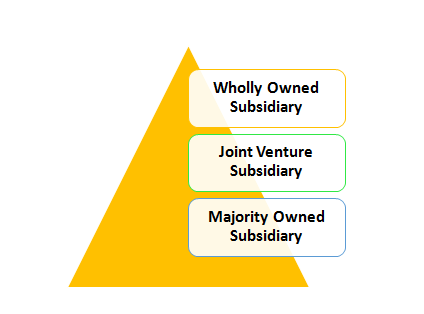
1- Wholly Owned Subsidiary (WOS): Foreign parent owns 100% shares, providing complete control over operations, decision-making, and profit distribution. This is the preferred structure for companies seeking maximum autonomy and control.
2- Joint Venture Subsidiary: Partnership between foreign and Indian entities, combining international expertise with local market knowledge. Ownership typically ranges from 51-99% for the foreign partner, depending on sector regulations and FDI policies.
3- Majority Owned Subsidiary: Foreign company holds 51-99% stake while minority Indian partners bring local expertise, regulatory compliance support, and market insights.
Key Benefits of Foreign Subsidiary Company Registration in India
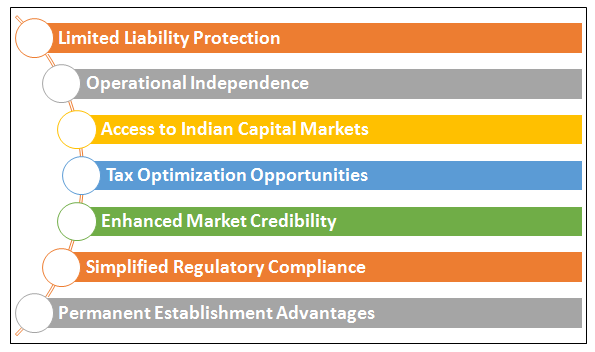
- Limited Liability Protection: – The parent company’s assets remain fully safeguarded against any debts, losses, or legal obligations of the subsidiary. This corporate shield ensures that risks are confined to the subsidiary alone.
- Operational Independence: – Foreign Subsidiaries in India have complete freedom to manage their daily operations, strategic planning, and decision-making. This autonomy allows quicker responses to market changes and better adaptation to local business needs.
- Access to Indian Capital Markets: – Being treated as a domestic entity, a foreign subsidiary can raise funds from Indian banks, financial institutions, and capital markets. This lowers financing costs and minimizes exposure to foreign exchange risks.
- Tax Optimization Opportunities: -Foreign subsidiaries enjoy Indian corporate tax benefits, favourable tax treaties, and government incentives. They can also structure profits efficiently through transfer pricing and repatriation strategies.
- Enhanced Market Credibility: -Operating as an Indian company builds stronger trust with local customers, vendors, and authorities. This credibility leads to better business relationships and smoother regulatory approvals.
- Simplified Regulatory Compliance: – Unlike foreign entities, subsidiaries follow Indian corporate laws directly. This reduces complexity, lowers administrative overhead, and ensures seamless compliance with local regulations.
- Permanent Establishment Advantages: – A subsidiary can engage in a wide range of lawful business activities without restrictions, unlike branch offices. It can also bid for government contracts, obtain licenses, and operate in sectors requiring Indian ownership.
Key Eligibility Criteria for Foreign Subsidiary Company Registration in India
| Eligibility Criteria | Requirements |
| Minimum Directors | At least 2 directors are required, and one must be a resident director in India (182+ days stay in a financial year). |
| Shareholding Structure | The foreign parent company must hold more than 50% of the total share capital. |
| Minimum Shareholders | At least 2 shareholders are required. (individuals or corporate entities, one must be foreign company ). |
| Registered Office Address | A valid registered office in India is mandatory. It can be rented/leased with NOC and utility bill proof. |
| Authorized Capital | No minimum paid-up capital requirement but the parent company should finalize an appropriate capital structure. |
| Compliance with FDI Policy | Business activity must comply with FDI guidelines (automatic or government approval route). |
Documents Required for Foreign Subsidiary Company Registration in India
| Category | Description | Documents Required |
| Director and Shareholder Documents | Identity Proof of Directors & Shareholders | Passport (for foreign nationals), Driving License / Aadhaar Card PAN Card (for Indian nationals). |
| Address Proof of Directors & Shareholders | Bank Statement /Utility Bill / Residence Permit (not older than 2 months). | |
| Photographs | Recent passport-size photographs of all directors and shareholders. | |
| Charter Documents (if foreign corporate is shareholder) | Apostilled/Notarized MOA & AOA of the parent companyA board resolution approving incorporation of the subsidiary. | |
| Parent Company Documents | Constitutional Documents of Parent Company | Certificate of Incorporation, Memorandum of Association (MOA), Articles of Association (AOA), and Board Resolution authorizing investment. |
| Registered Address Proof | Registered Office Proof in India | Rent Agreement / Lease Deed Ownership Documents along with NOC from the owner Latest Utility Bill. |
Step-By-Step Process of Foreign Subsidiary Company Registration in India
Foreign Subsidiary Company Registration in India involves a structured approach across five distinct phases. Here’s the complete process in a systematic manner to help you navigate the regulatory landscape effectively.
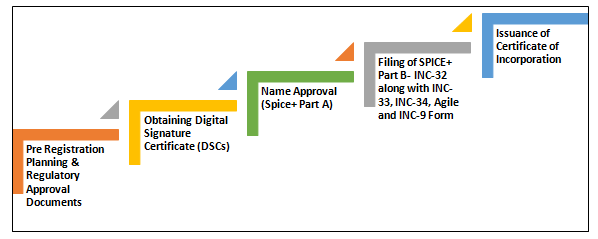
Step-1: – Pre Registration Planning & Regulatory Approval Documents: – The foundation of a successful subsidiary setup begins with thorough preparation and understanding of regulatory requirements. Determine the appropriate business structure, finalize the authorized share capital and shareholding pattern and decide on the registered office location and operational setup. Collect all requisite documents from Parent company and proposed shareholders and directors of the company. Prepare and collect in advance that require Apostille/Notarization. Draft Board resolutions of the parent company authorizing subsidiary formation and get the certified signed copy.
Verify sectoral FDI caps and entry route (automatic vs government approval) and obtain industry-specific licenses or approvals before incorporation (if mandated). Prepare foreign exchange compliance documentation and ensure proper classification under FDI policy.
Step-2: – Obtaining Digital Signature Certificate (DSCs): – The application of Foreign Subsidiary Company Registration is completely online, and Class 3 DSCs shall be applied for proposed directors and subscribers of the company.
Step: -3: – Name Approval (Spice+ Part A): – There are two alternative options available for the name approval on the MCA Website.
Option 1: -Reserving the name via Part-A of the SPICe+ Form
Option 2: – Name approval by filing Part-A and Part-B of the SPICe+ Form together
Apply for company name approval through SPICE+ Part A service on MCA portal and Submit 2proposed names in order of priority. After scrutiny, the ROC grants name approval certificate which is valid for 20 days further extendable by 20 days. In case, the name is not available, 2 free resubmissions are granted without extra fees to propose any other name that resonate with the proposed business activity.
Step: – 4- Filing of SPICE+ Part B- INC-32 along with INC-33, INC-34, Agile and INC-9 Form: – The fourth step is filing of Spice+ PART B form that leverages India’s streamlined digital infrastructure to complete multiple mandatory registrations simultaneously. This form
- Secure automatic allotment of Director Identification Numbers for up to three directors through the integrated system
- Process PAN and TAN registrations as mandatory components of the digital workflow
- Complete EPFO (Employee Provident Fund) and ESIC (Employee State Insurance) registrations automatically
- Initiate bank account opening procedures through the integrated banking interface
- Apply for GST registration if business operations require immediate tax compliance
The Spice+ form is designed with real-time data validation, and once both Part-A and Part-B are filled in, the details automatically flow into the connected forms like AGILE-PRO, e-MOA, e-AOA, INC-9, and other applicable filings.
Step- 5: -Issuance of Certificate of Incorporation: – Once the application and linked forms are duly verified and approved by the Registrar of Companies, the Certificate of Incorporation (COI) is issued. This COI serves as the conclusive evidence of the company’s legal existence and commencement.
With proper planning and professional assistance by My Legal Business LLP, foreign companies can ensure smooth and timely registration of their Indian subsidiary, helping them quickly establish their business presence through Foreign Subsidiary Company Registration in one of the world’s fastest-growing economy.
Expert Tips to avoid Potential Delays for Foreign Subsidiary Company Registration in India
One of the biggest challenges foreign companies during Foreign Subsidiary Company Registration in India is delay due to incomplete or incorrect paperwork. With the right preparation, you can significantly cut down the timeline and ensure a smoother registration process.
- Get Documents Ready in Advance: -Board resolutions, notarized documents, and the last 3 years’ financial statements are essential. Missing paperwork is the biggest cause of delay for Foreign Subsidiary Company Registration in India.
- Choose the Right Name: – Submit 3–5 unique name options to the MCA. Avoid generic or restricted terms and check the trademark database in advance to prevent rejection.
- Plan Capital Structure Carefully: – Define the paid-up capital, future funding requirements, and FDI compliance before filing. A well-planned structure saves time and avoids amendments later.
- Work with Local Experts: – Engaging experienced Indian consultants and legal professionals ensures that regulatory nuances and procedural details are handled correctly. Contact our expert team today to get free consultation.
- Don’t Ignore State-Level Approvals: – Along with central approvals, some states may require pollution control, labour, or establishment licenses. Address these early to avoid post-incorporation hurdles.
With thorough preparation and the right guidance, you can reduce the timeline for Foreign Subsidiary Company Registration from months to just a few weeks which will help your India operations go live much faster.
Why Choose My Legal Business LLP for Foreign Subsidiary Company Registration in India?
At My Legal Business LLP, we specialize in end-to-end support for Foreign Subsidiary Company Registration in India. From name approval, drafting, and MCA filings to ensuring FDI compliance and state-level clearances, our experts handle the entire process seamlessly. With proven experience, quick turnaround, and regulatory expertise, we make subsidiary registration fast, hassle-free, and 100% compliant.
Conclusion
Foreign Subsidiary Company Registration in India may seem complex, but following this step-by-step process makes it manageable and straightforward. The key to success lies in thorough preparation, complete documentation, and understanding the regulatory landscape that continues to evolve in 2025.
From obtaining Digital Signatures, name approval, and drafting incorporation documents to ensuring FDI compliance and regulatory clearances, each step plays a crucial role in building a strong foundation for your business in India. Timely preparation of documents, smart capital structuring, and professional assistance can significantly reduce delays and help you navigate both central and state-level requirements smoothly.
India continues to be one of the world’s fastest-growing economies, offering immense opportunities for global businesses. By following this step-by-step process and staying updated with the latest MCA and FDI regulations, foreign companies can establish their Indian presence quickly and compliantly in 2025. With a registered subsidiary, you not only gain legal credibility but also unlock the potential of India’s vibrant and expanding market.
Ready to expand? Start your Foreign Subsidiary Company Registration journey today and unlock the immense potential that the Indian market offers for your business growth.
Frequently Asked Questions
Q1: -Can a foreign subsidiary in India have a different financial year-end than its parent company?
Answer: Yes, Indian subsidiaries can choose their financial year independent of the parent company, but it must align with Indian regulatory requirements. The most common choice is April-March to match the Indian financial year, which simplifies tax compliance and statutory audits. However, you can opt for January-December if it aligns better with global reporting needs, though this may require additional compliance steps.
Q2: Is it possible to register a subsidiary in India using cryptocurrency or digital assets as paid-up capital?
Answer: Currently, RBI guidelines do not recognize cryptocurrency as legitimate capital contribution for company registration. All paid-up capital must be brought through banking channels in convertible foreign currency. While regulations around digital assets are evolving, as of 2025, only traditional fiat currencies are acceptable for subsidiary registration purposes.
Q3: What are the implications if my parent company’s country doesn’t have a Double Taxation Avoidance Agreement (DTAA) with India?
Answer: Without DTAA protection, your subsidiary will face higher tax withholding rates on dividends, royalties, and technical fees paid to the parent company. However, this doesn’t affect the registration process itself. You can still register the subsidiary but should factor in the higher tax costs in your financial planning.
Q4: Can my subsidiary be registered in a different state from where I plan to have the registered office initially?
Answer: No, the state of registration and registered office must match initially. However, you can later shift the registered office to another state through a complex process involving special resolutions, creditor notifications, and approvals from both origin and destination state ROCs. It’s better to choose the correct state from the beginning based on your operational and tax strategy.
Q5: Can a subsidiary be registered if the parent company’s business activities are legal in its home country but restricted under Indian law?
Answer: The subsidiary can only engage in activities that are legally permissible in India, regardless of the parent company’s business scope. For example, if cannabis-related business is legal in the parent’s jurisdiction but restricted in India, the subsidiary cannot engage in such activities. During registration, ensure all proposed business activities comply with Indian laws, FDI policies, and licensing requirements. The subsidiary essentially becomes a separate legal entity governed by Indian regulations.
ALSO READ
Conversion of Partnership Firm into LLP
Limited Liability Partnership Registration Process in India
Conversion of LLP into a Private Limited Company in India
Key Highlights of the Online Gaming Bill 2025